Introduction
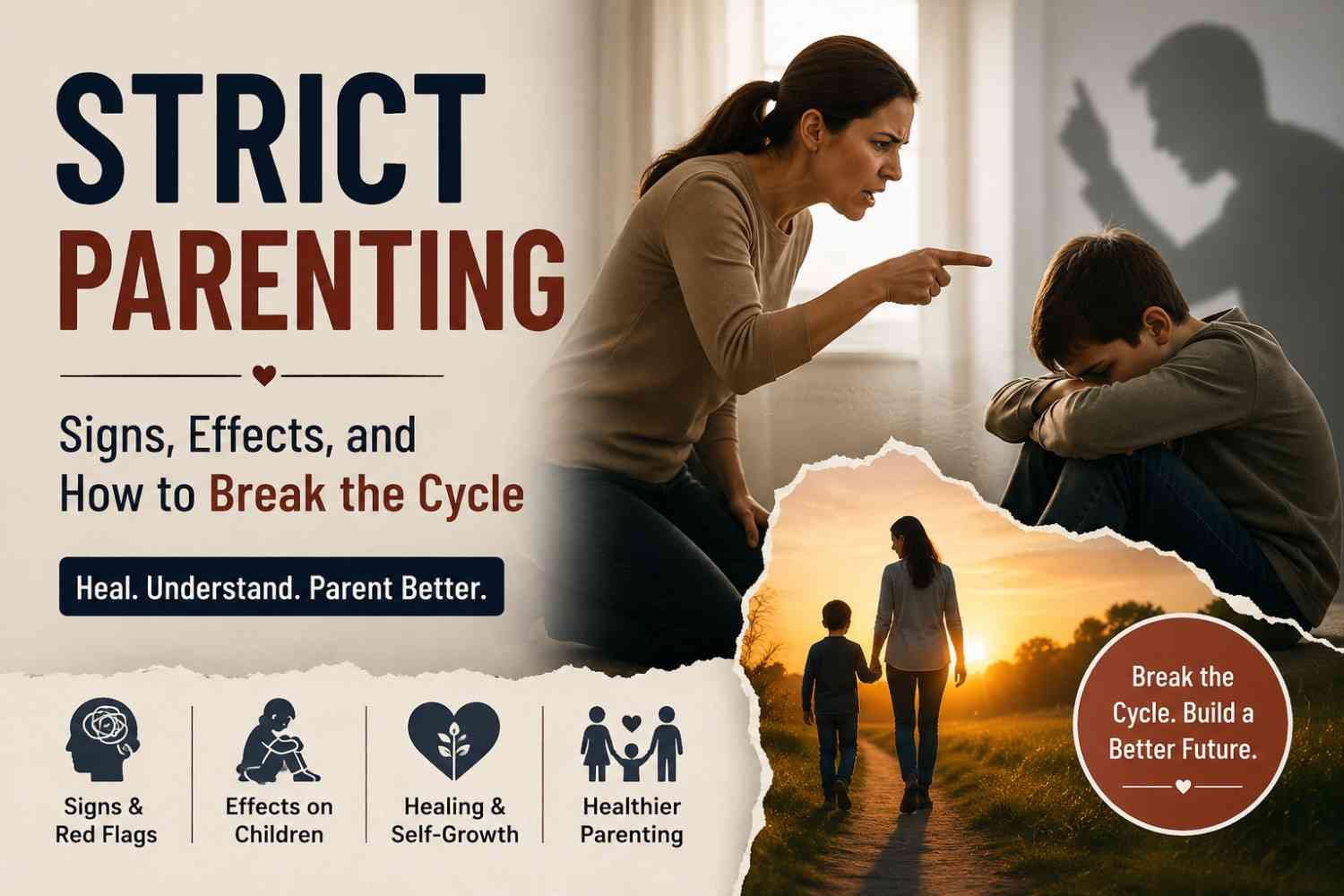
Strict parenting is common in many families, especially in India. Many parents believe that being strict helps children become successful, disciplined, and responsible. But when strictness turns into fear, control, shame, or emotional distance, it can leave deep marks on a child’s mind and heart.
This article is for two kinds of people:
- Adult children who grew up with fear-based parenting and still feel its effects today
- Parents who want to raise their children with discipline, but without repeating harmful patterns
The goal is not to blame parents or children. The goal is to understand the pattern, heal from it, and create healthier families.
Healing takes time, and every small step toward self-understanding matters. If you’re looking for comforting words to help you process difficult emotions and move forward with hope, explore our collection of Emotional Quotes for encouragement and inspiration during your healing journey.
Self-Assessment Quiz -Where Do You Stand?
A Quick Self-Check
Start by understanding how strongly your childhood still affects you. A short diagnostic quiz can give useful direction. Score each item: often = 1, sometimes = 0.5, never = 0.
- I plan what I will say before calling my parents.
- I tense up when a parent calls.
- I have never made a big life decision entirely on my own.
- I feel awkward showing strong emotions around my parents.
- I apologize for things that are not my fault.
- My parents compare me to others.
- I feel relief, not joy, after achievements.
- I fear parental rejection if I reveal my true self.
- I keep a whole second life from my parents.
- I find it hard to say no.
- My parents never genuinely apologize to me.
- I never share emotional needs with my parents.
- I remember harsh scolding or physical punishment.
- I feel I live to fulfill my parents’ dreams.
- I worry I might do the same to my own children.
Scoring bands
Example:
0–3: Mostly healthy
4–7: Moderate inheritance
8–11: Heavy inheritance
12–15: Crisis territory
Use your score as information, not a judgment.
Understanding Strict Parenting: What Research Says
Researchers have long studied how different parenting approaches shape a child’s growth. In the 1960s, psychologist Diana Baumrind introduced three main parenting styles. Her work was later expanded by Eleanor Maccoby and John Martin, who added a fourth style. These four parenting styles are now widely used to understand how parents balance discipline, emotional support, communication, and expectations.
Psychologists often divide parenting into four styles: authoritative, authoritarian, permissive, and uninvolved. Out of these, the one most closely linked to harmful strictness is authoritarian parenting.
This style is built on high control and low warmth. Rules are enforced, but not explained. Questions are seen as disrespect. Emotions are dismissed. Love may be present, but it is not always felt. Approval is often conditional. Children are expected to obey first and feel later, if at all.
What makes this style especially difficult is that it is often socially accepted. In many cultures, including Indian families, harsh parenting may be normalized. A child is compared to others “for motivation.” A career is chosen “for security.” A marriage is pressured “for society.” Emotional expression is discouraged “for strength.”
Over time, this parenting style does not simply guide behaviour. It shapes identity.
Parenting experts emphasize that children benefit most from a balance of warmth, clear expectations, and consistent guidance. For more evidence-based parenting recommendations, you can explore the resources provided by the American Academy of Pediatrics.
Common Myths About Strict Parenting
Many parents are strict because they want the best for their children. However, some common beliefs about strict parenting are based on misconceptions rather than facts. Understanding these myths can help parents build a healthier balance between discipline and emotional support.
Myth 1: Strict parents always raise well-behaved children.
Reality: Children may obey out of fear, but that doesn’t always mean they understand right from wrong. Healthy behavior grows from guidance, not fear.
Myth 2: Harsh punishment builds strong character.
Reality: Children learn better through patience, clear rules, and logical consequences than through fear or physical punishment.
Myth 3: Being very strict keeps children out of trouble.
Reality: When children fear harsh reactions, they may hide mistakes or avoid asking for help instead of being honest.
Myth 4: Fear is the same as respect.
Reality: True respect comes from trust, understanding, and consistent guidance—not from intimidation.
Myth 5: Children need constant control to stay disciplined.
Reality: Children do need boundaries, but they respond best when those boundaries are firm, fair, and supported with kindness and open communication.
Healthy Discipline vs. Fear-Based Parenting
Although both approaches aim to guide children, they lead to very different outcomes. Healthy discipline teaches children through understanding, patience, and clear boundaries. Fear-based parenting relies on control, punishment, or intimidation to enforce obedience. While fear may stop unwanted behavior for a short time, it rarely teaches children how to make better choices in the future.
Fear-Based Parenting | Healthy Discipline |
Uses fear, threats, or harsh punishment | Uses guidance, patience, and clear expectations |
Focuses on immediate obedience | Focuses on learning and personal growth |
Children behave to avoid punishment | Children behave because they understand right from wrong |
Can create fear, anxiety, or secrecy | Builds confidence, trust, and emotional security |
Weakens communication over time | Encourages open and honest communication |
May damage the parent-child relationship | Strengthens long-term family relationships |
Healthy discipline is not about being permissive. It means setting firm boundaries while treating children with respect, empathy, and consistency. This approach helps children develop self-control, confidence, and the skills they need to make responsible decisions throughout life.
UNICEF also encourages positive parenting practices that combine love, communication, and appropriate boundaries to help children develop confidence and emotional resilience.
The Three Types of Inheritance
Strict parenting doesn’t just affect your childhood. It stays with you in three ways:
Emotional
You take criticism personally, need constant approval, feel guilty when resting, fear conflict
Behavioural
You people-please, can’t say no, hide your opinions, put others’ needs first
Body
You have tense shoulders, shallow breathing, trouble sleeping, feel drained after family gatherings
The most ignored part? Body inheritance. Your body stores trauma too — jaw tension, digestion issues, tiredness after family events. Full healing must involve the body, not just the mind.
9 Signs Strict Parenting May Still Be Affecting You
Check if any of these signs feel familiar. If they do, you’re still carrying the weight of your childhood.
Red Flag #1 — You apologize for everything. Wrong order at a restaurant? You say sorry. Someone bumps into you on the bus? You say sorry. This is a trained reflex from childhood, where you were taught the mistake is always yours.
Red Flag #2 — You read everyone’s mood like a detective. You walk into a room and instantly sense the atmosphere. This hyper-vigilance kept you safe as a child. But as an adult, it drains you completely.
Red Flag #3 — You feel relief, not joy, after success. You pass the exam. You get the promotion. And your reaction is: “Thank god, that’s over.” Happiness doesn’t come because you’ve been performing for an invisible audience your whole life.
Red Flag #4 — You have two different personalities. At home you are quiet and agreeable. Outside you are loud and free. You don’t even know which version is the real you anymore.
Red Flag #5 — Saying “no” feels impossible. Even when you’re exhausted, you say “yes.” And when you finally say “no,” guilt burns inside you for hours.
Red Flag #6 — Your parents’ approval still matters more than your own. Colleagues respect you. Your partner appreciates you. But until your parents say “well done,” the achievement feels incomplete.
Red Flag #7 — You hide your emotional life from your parents. Your first heartbreak, your biggest failure, your panic attacks — they know nothing. You give them a filtered version of your life, and it leaves you feeling deeply alone.
Red Flag #8 — Compliments make you uncomfortable. Someone praises you, and you deflect. Someone gives you a gift, and you feel awkward. Your childhood taught you that love was conditional — praise only for achievements, never for just being you.
Red Flag #9 — There is constant anxiety inside you. You are safe. You are healthy. You have a job. Yet a background hum of fear never switches off. Something bad is about to happen. Your nervous system is still in war mode, even in peace.
Decoding Your Parents
Many strict parents were also raised in strict homes. They may have grown up with poverty, fear, social pressure, emotional neglect, or harsh discipline. This does not excuse harmful behavior, but it helps explain it.
Some parents believe:
- fear creates discipline
- obedience means respect
- emotional softness makes children weak
- society matters more than personal happiness
Often, they are not acting from wisdom. They are acting from their own unresolved fear.
Understanding this can reduce confusion and anger. But understanding does not mean accepting unhealthy behavior forever.
Healing After Strict Parenting
Healing begins when you stop blaming yourself for the patterns you learned in order to survive.
The first step is awareness. Notice your reactions. Notice where you shrink, where you over-explain, where guilt appears, and where fear takes control. Ask yourself whether the present situation is truly unsafe, or whether it reminds your body of old experiences.
Writing can also help. Journaling about your childhood messages, family expectations, and emotional habits can make hidden patterns visible. Therapy can be another powerful step, especially if fear, anxiety, or people-pleasing affect your daily life.
Most importantly, healing asks you to slowly build a new relationship with yourself. One where your feelings matter, your needs are valid, and your worth is not decided only by achievement or approval.
Healing is more than overcoming painful experiences—it is also about becoming the person you want to be. If you’re ready to focus on building confidence, resilience, and a healthier mindset, explore our guide on The Road to Growth: Unlocking the Foundations of Self-Improvement and Personal Development.
If past parenting experiences continue to affect your emotional well-being, seeking support from qualified mental health professionals can be helpful. The American Psychological Association offers reliable information on emotional health, resilience, and finding professional support.

Healing Yourself -practical exercises
Healing is not quick. It is not easy. But it is possible. Here are some practical steps.
Heal Emotional Inheritance
- Notice the reflex — Before apologizing for something that isn’t your fault, pause and ask: “Is this actually my fault?”
- Practice accepting compliments — When someone praises you, just say “thank you.” That’s it. No deflecting.
- Allow yourself feelings — Your feelings are not inconvenient. They are information.
Heal Behavioural Inheritance
- Start small with “no” — Say no to a small request first. Then work your way up.
- Write down your own opinions — Before asking others what they think, ask yourself first.
- Stop performing — You don’t need to be the “good child” anymore. You are an adult now.
Heal Body Inheritance
- Breathe — When you feel tension, take slow, deep breaths. Your body needs to know it is safe.
- Move — Walk, stretch, or exercise. Trauma lives in the body, and movement helps release it.
Rest without guilt — Your body is not a machine. You are allowed to rest.
Personal growth happens through small, consistent actions rather than overnight changes. Developing healthy habits, setting realistic goals, and managing your time wisely can make the healing journey more effective. Read our guide on Time Management for Students to learn practical strategies that help build discipline and confidence in everyday life.
Conversations You Need to Have
This is the most practical part. Here are simple scripts you can use with your parents, covering the five biggest battlegrounds: Career, Money, Marriage, Boundaries, and Society’s Opinions.
The Golden Rule: Use the 3-Part Structure
Every conversation should follow this structure:
I-statement → Observation → Ask
Step | Example |
I-statement (your feeling) | “I feel stressed when…” |
Observation (the fact) | “Last week you asked me three times about marriage.” |
Ask (clear request) | “Can we talk about this once a month instead?” |
6 Ground Rules Before You Start
- Pick the right time — Not on the phone, not late at night, never in front of guests.
- Don’t ambush — Say “Dad, I need to talk about something important.”
- Stay calm if they don’t — They may get angry or use emotional blackmail. Your job is to stay calm.
- Don’t try to “win” — The goal is to put your point clearly, not to convince them.
- You can walk away — If things escalate, say “I’ll talk later” and leave. This is not weakness.
- One conversation is not enough — Important things take many talks over many months.
Career Scripts (Shortened for Quick Use)
Situation 1: You want a gap year
“I feel I’m not ready for college yet. Without clarity, four years and a lot of money will be wasted. I want a one-year break with a written plan. I’ll update you monthly.”
Situation 2: You want to switch streams
“For the last few months I’ve realized this stream is not for me. I’ve researched the new path — here are the career options and salaries. This is not a shortcut. Can we discuss this calmly?”
Situation 3: You don’t want to write JEE/NEET/UPSC
“I’m not writing this exam. I know this was your expectation. But I have no interest, and forcing myself will waste years. I’m choosing a different path. I hope for your support.”
Situation 4: You want to leave a high-paying job
“I’m leaving my job. I know the salary is good, but I’m empty inside. I have X months of savings. I need your emotional support, not money. Please don’t tell me I’ve gone crazy.”
Situation 5: You want a creative career
“In your generation creative work meant struggle. But today it’s a growing industry. Let me show you examples. Here’s my plan with specific steps. I just need you to take me seriously.”
If You Are Parenting Differently Than You Were Raised
Many parents want to give their children a different childhood than the one they experienced. If you grew up with very strict rules, fear, or limited emotional support, it’s natural to wonder how you can parent differently. Breaking old patterns isn’t always easy, but small, thoughtful changes can make a big difference over time.
Follow with practical tips:
- Pause and take a deep breath before reacting.
- Explain rules calmly instead of shouting.
- Listen to your child’s feelings before correcting their behavior.
- Admit your mistakes and apologize when necessary.
- Praise effort, kindness, and progress—not just achievements.
- Be consistent with rules while showing love and understanding.
- Encourage open conversations so your child feels safe sharing their thoughts.
No parent is perfect, and change doesn’t happen overnight. Every small step toward more understanding, patience, and positive communication helps create a stronger and healthier relationship with your child.
Signs Your Parenting Style May Be Too Strict
Every parent wants the best for their child, and it’s natural to set rules and expectations. However, if discipline is based mainly on fear or control, it may affect your child’s confidence and emotional well-being. Take a moment to reflect on the following signs—not to judge yourself, but to understand whether small changes could strengthen your relationship with your child.
Does your child hide their mistakes?
If your child is afraid to admit mistakes, they may be more worried about your reaction than about the mistake itself. Children are more likely to be honest when they know they will be listened to with patience and understanding.
Is your child afraid to disagree with you?
Children should feel comfortable expressing their thoughts respectfully. If they remain silent because they fear criticism or punishment, it may be a sign that open communication is missing.
Does your child ask permission for every small decision?
Seeking guidance is healthy, but needing approval for every little choice may suggest that your child lacks confidence in making decisions independently.
Does your child fear your reaction more than the consequences?
When children behave only to avoid anger or punishment, they may not fully understand the reason behind the rules. Healthy discipline helps children develop responsibility because they understand the value of good choices—not simply because they fear the outcome.
Moving Forward
If you recognized some of these signs, don’t be discouraged. Parenting is a journey of learning and growth. Small changes—such as listening more, explaining rules calmly, and encouraging honest conversations—can build greater trust and help your child feel safe, confident, and supported as they grow.
Parent Repair Script
For Parents — How to Break the Cycle
If you are a parent and you don’t want to repeat your own parents’ mistakes, this section is for you.
Things to STOP Doing
- ❌ Stop saying “because I said so” — Explain your reasons.
- ❌ Stop comparing your child to others — It damages self-worth permanently.
- ❌ Stop dismissing emotions — “Stop crying” teaches children that feelings are wrong.
- ❌ Stop punishing mistakes — Mistakes are learning opportunities, not crimes.
- ❌ Stop controlling everything — Children need space to make their own choices.
Things to START Doing
- ✅ Start apologizing — Say “I’m sorry” when you are wrong. This teaches your child accountability.
- ✅ Start listening — Really listen, without preparing your response while they speak.
- ✅ Start explaining — “We have this rule because…”
- ✅ Start allowing emotions — “I can see you’re angry. That’s okay. Let’s talk about it.”
- ✅ Start praising effort, not just results — “I’m proud of how hard you tried.”
The Repair Script
If you have made mistakes as a parent (and all parents do), here is how to repair:
“I want to talk about something. I’ve been thinking about how I handled [situation]. I think I was wrong. I reacted out of my own fears, and I didn’t listen to you properly. That was not fair. I’m sorry. I want to do better. Can we talk about it?”
This may feel uncomfortable. But it is one of the most powerful things a parent can say.
FAQ :Strict parenting
Start small. Don’t expect big changes overnight. Use the 3-part structure (I-statement → Observation → Ask) and pick one issue at a time. If the conversation gets heated, walk away and try again later. Remember — the goal is not to convince them. The goal is to express yourself clearly.
It is never too late to repair. Children are incredibly forgiving when they see genuine effort. Use the repair script mentioned in Section 5. Say sorry. Explain your feelings. And most importantly, change your behaviour going forward.
This is very common. Sit down together and discuss your own childhoods. Understanding where each of you comes from will help you find common ground. Agree on basic rules together, and present a united front to your children.
Absolutely not. Your score is not your worth. It is only information that shows you where to start. Many people with high scores have healed completely with time, effort, and so metimes professional help.
If you scored in the “heavy” or “crisis” range, or if you feel stuck despite trying, therapy can be extremely helpful. A good therapist will give you tools that accelerate healing significantly. There is no shame in getting professional support.
You cannot control your parents. But you can control your own response. Even if they never change, you can change how you react to them. You can set boundaries. You can choose what to share and what to keep private. Your healing does not depend on their change.
Healing is not a straight line. Some people feel better in months. For others, it takes years. The important thing is not the speed — it is the direction. As long as you are moving forward, even slowly, you are healing.
Strict parenting is about control — “Do this because I said so.” Disciplined parenting is about guidance — “Here is the rule, and here is why it matters.” One creates fear. The other creates understanding. Aim for the second.
Conclusion
Strict parenting may come from love, worry, or tradition, but when it relies on fear, shame, or emotional control, it can leave lasting damage. Children may follow rules, but they may also lose confidence, emotional openness, and trust.
The goal of parenting is not just to raise obedient kids. It is to raise capable, grounded, kind, and emotionally healthy human beings.
That is why the best parenting approach is not harsh control or total freedom. It is firm, respectful guidance rooted in connection. When children feel safe, heard, and supported, they are more likely to grow into responsible adults who can think for themselves and maintain strong family relationships.
Parents do not need to be perfect. They just need to be willing to lead with both structure and empathy.