
Quick Answer
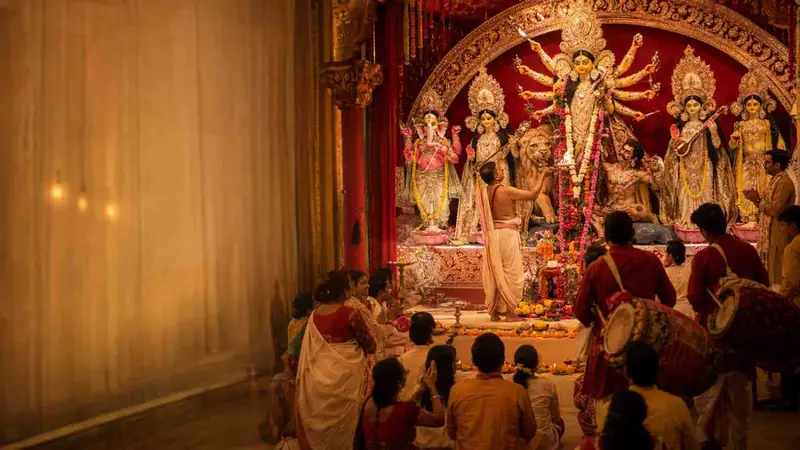
Durga Puja is a major Hindu festival dedicated to Goddess Durga and her victory over Mahishasura, symbolising the triumph of good over evil. The sacred observance extends across ten days, although the main public celebrations usually take place from Shashthi to Vijayadashami. It is especially important in West Bengal, where devotion, artistic pandals, community worship, food, music and cultural programmes come together in one of India’s most celebrated festivals.
Introduction
Goddess Durga is worshipped in Hindu tradition as a powerful manifestation of Shakti—the divine feminine energy associated with courage, protection, motherhood and the restoration of moral order. Her best-known sacred narrative describes her defeat of Mahishasura, the buffalo demon whose power had disturbed peace and balance.
Durga Puja honours this victory while also welcoming the Goddess as a beloved daughter returning to her maternal home. In Bengali tradition, she is commonly represented with Lakshmi, Saraswati, Ganesha and Kartikeya, creating both a divine image of victory and an affectionate family setting.
Millions of devotees celebrate the festival through worship, fasting, anjali, bhog, cultural performances, family gatherings and visits to elaborately designed pandals. In West Bengal, particularly Kolkata, the festival has developed into a major expression of public art, craftsmanship and community cooperation.
Durga Puja is now celebrated far beyond Bengal. Bengali communities throughout India and abroad recreate its religious and cultural atmosphere through community worship, music, food and social programmes. UNESCO describes it as a living heritage practised in Kolkata, other parts of India and among the Bengali diaspora.
This evergreen Durga Puja Festival Guide explains the festival’s meaning, mythology, history, important days, rituals, food, pandals, cultural significance and worldwide celebration. It also introduces dedicated HuntBliss collections for wishes, quotes, captions, status messages, mantras, anjali and puja samagri without repeating those topics in excessive detail.
📖 Key Takeaways
- Durga Puja honours Goddess Durga and her victory over Mahishasura.
- The festival represents the triumph of righteousness, courage and divine power over destructive forces.
- It is observed over a sacred ten-day period, with the main celebrations from Shashthi to Dashami.
- Mahalaya announces the arrival of Devi Paksha and creates the spiritual atmosphere for the festival.
- Bodhan, Pushpanjali, Sandhi Puja, Kumari Puja and Visarjan are among its important rituals.
- Kolkata is famous for artistic pandals, clay idols, lighting and community celebrations.
- Durga Puja in Kolkata entered UNESCO’s Representative List of the Intangible Cultural Heritage of Humanity in 2021.
- Bhog commonly includes khichuri, labra, vegetables, chutney, payesh and sweets.
- Dhak, dhunuchi dance, drama, music and cultural evenings form an important part of the celebration.
- Bengali communities in India and abroad observe Durga Puja as a festival of devotion, identity, reunion and cultural continuity.
📚 Table of Contents
What Is Durga Puja?
Durga Puja is an annual Hindu festival devoted to the worship of Goddess Durga. It commemorates her victory over Mahishasura and expresses the belief that truth, courage and dharma ultimately overcome injustice and destructive power.
The word “puja” refers to reverential worship through prayers, offerings, sacred recitations and ritual acts. Therefore, Durga Puja literally means the worship of Goddess Durga.
The festival is especially important in West Bengal, Assam, Odisha, Tripura and other parts of eastern India. It is also observed in homes, temples and community halls throughout India and among Bengali communities overseas.
In Bengal, Durga Puja is both a religious observance and a major social event. Its most recognisable elements include:
- Clay images of Goddess Durga and her divine family
- Temporary worship spaces known as pandals
- Bodhan and other consecration rituals
- Pushpanjali and devotional prayer
- Dhak music and dhunuchi dance
- Community bhog
- New clothes and family gatherings
- Cultural programmes
- Pandal visits
- Vijayadashami and image immersion
The Durga Puja Festival therefore brings together spirituality, mythology, sculpture, architecture, music, food and community participation.
History and Origin of Durga Puja
The religious foundations of Durga worship are ancient. Goddess traditions developed through different streams of Hindu belief, including the worship of the divine feminine as Shakti or Power. Images of Durga defeating Mahishasura have appeared in South Asian art for many centuries; the Metropolitan Museum of Art, for example, holds historical representations connected with this sacred theme.
The Devi Mahatmya, a revered section of the Markandeya Purana, is central to the devotional tradition surrounding Durga’s battles against destructive forces. Its recitation, commonly known in Bengal as Chandi Path, remains closely associated with the spiritual atmosphere of Durga Puja.
Development in Bengal
The History of Durga Puja in Bengal includes both household worship and public community celebration. Wealthy landowning and aristocratic families once organised elaborate private pujas in their homes. These gatherings combined worship with hospitality, music and social prestige.
Over time, community-based forms became increasingly important. Public or sarbojanin pujas allowed residents, craftspeople, local businesses and volunteers to participate collectively. UNESCO notes that the festival developed from elite household celebrations into community observances that welcomed people from different social backgrounds.
During the modern period, Durga Puja expanded beyond ritual worship. Pandals became increasingly artistic, idols developed diverse visual styles, and neighbourhood committees began organising cultural events, social services and large-scale public celebrations.
Today, the festival preserves traditional worship while constantly renewing its artistic language. A single Durga Puja Pandal may draw inspiration from Bengal’s village crafts, historic architecture, environmental concerns, literature or contemporary social themes. Incredible India describes Kolkata’s theme pandals as carefully constructed temporary spaces involving sculptors, artists and lighting specialists.
Story of Goddess Durga and Mahishasura
According to a widely revered Hindu narrative, Mahishasura gained immense power and used it to challenge divine and moral order. His strength and arrogance made him difficult for the gods to defeat.
The divine powers then united, and from their combined energy emerged Goddess Durga. She was radiant, courageous and equipped with weapons and blessings associated with different deities. Her multiple arms symbolised her extraordinary power and ability to protect creation on many levels.
Durga confronted Mahishasura and the forces under his command. The battle represents a conflict between disciplined divine strength and destructive power driven by pride, violence and injustice. Ultimately, Durga defeated Mahishasura and restored balance.
The Metropolitan Museum of Art identifies the destruction of the buffalo demon Mahishasura as one of Durga’s most celebrated sacred feats. Her multiple arms in Hindu art communicate immense divine power rather than an ordinary human form.
Symbolism of the Story
The Story of Durga Puja can be understood on several levels:
- Durga represents courage guided by wisdom.
- Mahishasura represents uncontrolled arrogance and destructive desire.
- The battle represents the inner struggle between positive and harmful tendencies.
- The Goddess’s weapons signify different forms of divine ability and responsibility.
- Her victory expresses the restoration of dharma and balance.
These interpretations should be understood as devotional and philosophical readings. Different Hindu traditions, teachers and regional communities may explain individual symbols in slightly different ways.
Symbols of Goddess Durga and Their Meanings
Images of Goddess Durga contain several sacred symbols connected with courage, protection, wisdom and divine power. In Bengali Durga Puja iconography, she is commonly shown with ten arms, carrying different weapons and standing or riding beside her lion while defeating Mahishasura.
The exact number of arms, objects and visual details may vary across regions, texts and artistic traditions. Museums such as The Metropolitan Museum of Art and the British Museum document Durga images with four, eight or ten arms, although the ten-armed form is especially familiar in Bengal. Her many weapons are traditionally understood as gifts or powers associated with different deities.
Trident or Trishul
The trident is one of the most recognisable weapons carried by Goddess Durga. It is traditionally associated with Lord Shiva and is frequently shown piercing Mahishasura in representations of Mahishasuramardini.
The trident is commonly interpreted as a symbol of power over destructive forces. Its three points are also sometimes associated with the three qualities of nature—sattva, rajas and tamas—or with the past, present and future. Such symbolic explanations may vary among religious traditions and teachers.
Lion
The lion is Durga’s sacred vehicle or vahana. It accompanies her into battle and often appears attacking Mahishasura beside the Goddess.
The lion represents courage, strength, confidence and controlled power. Durga’s command over the lion is commonly understood as mastery over fear, anger and uncontrolled instincts.
Lotus
The lotus is associated with purity, spiritual growth and inner awakening. Because the flower grows in muddy water while remaining clean and beautiful, it is often used in Hindu thought to represent a person who lives in the world without being overcome by negativity.
When held by Goddess Durga, the lotus may remind devotees to develop wisdom, dignity and spiritual awareness even during difficult circumstances.
Conch
The conch, or shankha, is a sacred object used in Hindu worship. Its sound traditionally announces the beginning of prayer, awakens spiritual attention and creates an auspicious atmosphere.
In some representations of Durga, the conch forms part of the collection of divine objects and weapons placed in her hands. Historical museum examples also show Durga holding both a conch and a chakra.
Chakra
The chakra is a circular divine weapon commonly associated with Lord Vishnu. In images of Durga, it represents protective energy, alertness and the power to act decisively against injustice.
Its circular form may also suggest continuous movement, cosmic order and the unending nature of divine energy. Durga is shown carrying the discus in several historic artistic representations.
Sword
The sword represents courage, knowledge and clear judgement. It is often interpreted as the power of wisdom that cuts through ignorance, confusion and false pride.
In the Mahishasuramardini tradition, it is also a practical battle weapon demonstrating that divine power is prepared to confront destructive forces directly. Museum records show Durga carrying a sword together with other sacred weapons.
Multiple Arms
Goddess Durga’s multiple arms express her extraordinary divine capability. They allow her to carry several weapons and sacred objects at the same time, showing that she possesses many forms of power while remaining calm and controlled.
According to the sacred narrative, different divine beings offered their weapons and energies to Durga so that she could defeat Mahishasura. Her many arms therefore represent united divine strength rather than ordinary human anatomy.
In Bengali Durga Puja, she is most commonly represented with ten arms. However, historical sculptures and paintings may show four, eight, ten or another number of arms depending on the period, region and artistic tradition.
Together, the trident, lion, lotus, conch, chakra, sword and multiple arms present Goddess Durga as compassionate yet powerful. They remind devotees that true strength should be guided by wisdom, discipline and the protection of righteousness.
Why Is Durga Puja Celebrated?
The simplest answer to “Why Durga Puja Is Celebrated?” is that devotees honour Goddess Durga’s victory over Mahishasura. The festival celebrates the triumph of good over evil, courage over fear and justice over oppression.
However, the celebration carries several interconnected meanings.
Worship of Divine Power
Durga is revered as a manifestation of Shakti, the energy through which creation is protected and transformed. Worshippers seek strength, wisdom, protection and the ability to overcome personal and social difficulties.
Devotion to the Divine Mother
Many devotees approach Durga not only as a warrior goddess but also as the compassionate Mother. The festival creates an emotional relationship between worshipper and deity based on trust, protection and surrender.
Return of the Daughter
In Bengali imagination, Durga’s annual arrival is often compared to a married daughter visiting her parental home with her children. This explains the warmth, celebration and sadness associated with her arrival and departure.
Renewal of Community Life
Families reunite, neighbourhoods work together and visitors move through public spaces filled with art and music. Durga Puja Celebration renews social connections as well as religious devotion.
Religious Significance of Durga Puja
Durga Puja is especially important within Shakta traditions, which recognise the Goddess as the supreme or central expression of divine power. Shakti literally means power or energy and occupies a major place within Hindu religious and artistic traditions.
Durga and Shakti
The Goddess is worshipped as the source of courage, protection and transformation. Her fierce form is not interpreted simply as anger; it represents controlled power directed against injustice and disorder.
Durga Puja and Navaratri
Durga Puja overlaps with Navaratri, the nine-night festival dedicated to different forms of the Goddess. However, their regional expressions are not identical.
In many parts of India, Navaratri emphasises fasting, worship of the Navadurga forms, Garba, Dandiya or Ramleela. In Bengal, the public celebration centres strongly on Durga’s image, the sacred family ensemble, community pandals and the main days from Shashthi to Dashami.
Both traditions celebrate divine feminine power and conclude around Vijayadashami, but their rituals, foods and cultural atmosphere may differ.
Devotion and Self-Reflection
For devotees, the festival is an opportunity to examine fear, anger, selfishness and pride. The outward victory of Durga encourages an inward effort to overcome harmful tendencies with discipline, compassion and moral courage.
Durga Puja UNESCO Recognition
In 2021, “Durga Puja in Kolkata” was inscribed on UNESCO’s Representative List of the Intangible Cultural Heritage of Humanity. This recognition applies to the living cultural practice—not to one particular idol, pandal or building.
UNESCO’s description highlights several connected elements:
- Clay-image craftsmanship
- Temporary pandal architecture
- Ritual worship
- Music and performance
- Collaborative work by artists and designers
- Community participation
- Transmission of knowledge across generations
- The festival’s inclusive public character
The recognition matters because Durga Puja is not preserved inside a museum. It is recreated every year through the work of artisans, priests, organisers, musicians, volunteers and worshippers.
Kolkata becomes an open cultural space where religious devotion and public art meet. The West Bengal Heritage Repository describes Durga Puja as a ten-day collective worship enriched by folk music, cuisine, craft and performing arts.
UNESCO recognition also creates responsibility. Organisers and visitors must support artisans, protect ritual knowledge, improve accessibility, reduce waste and make public celebrations safer and more inclusive. Recent UNESCO initiatives have also stressed accessibility in Durga Puja celebrations.
Ten Days of Durga Puja
Durga Puja is commonly described as a ten-day observance, although its most visible public celebrations are concentrated in the final days. Mahalaya creates the spiritual beginning, while the formal worship becomes especially prominent from Shashthi through Vijayadashami. UNESCO and Incredible India both describe the festival through a ten-day sacred framework.
Mahalaya
Mahalaya marks the end of Pitru Paksha and the beginning of Devi Paksha. Many devotees perform tarpan in remembrance of ancestors.
In Bengal, listening to the devotional recitation and musical presentation of Mahishasuramardini before sunrise is a deeply cherished cultural practice. Mahalaya creates the emotional feeling that the Goddess is approaching.
Mahalaya should not be confused with Shashthi, the day on which the main public worship formally begins.
Pratipada to Panchami
These early days form part of the wider Navaratri period. Puja committees complete pandals, artisans finish the images and families prepare clothes, gifts and food.
Public crowds may begin visiting important pandals before Shashthi, but the central ritual sequence has not yet reached its peak.
Shashthi
Shashthi formally welcomes Goddess Durga. Bodhan, Amantran and Adhivas rituals awaken, invite and establish the divine presence for worship.
The face of the Goddess is ceremonially unveiled in many pandals. The evening often marks the beginning of large-scale pandal visits and community celebrations.
Saptami
Saptami begins with the Nabapatrika ritual. Nine plants are ceremonially brought, bathed and placed near Ganesha in the worship area.
The ritual is popularly associated with Kola Bou, although the Nabapatrika represents a sacred group of nine plants rather than merely a banana plant. Formal worship, scripture recitation, bhog and public participation continue throughout the day.
Ashtami
Maha Ashtami is among the most important days of Durga Puja. Devotees gather for Pushpanjali and offer flowers while mantras are recited.
Many people wear traditional clothing and visit several pandals. Kumari Puja is also performed in certain institutions and traditions on Ashtami or another selected day.
Sandhi Puja
Sandhi Puja takes place at the sacred junction between Ashtami and Navami. It commemorates an intense moment in the Goddess’s battle against destructive forces.
Traditional observances may include lamps, lotus flowers, mantras and carefully timed offerings. Exact practices depend on the puja tradition and guidance of the priest.
Navami
Navami represents the concluding phase of the main battle and worship. Elaborate puja, homa or sacred fire offerings, bhog and cultural programmes may be performed.
The atmosphere combines celebration with an awareness that the Goddess’s departure is approaching.
Dashami
Vijayadashami celebrates Durga’s victory and concludes the main festival. Married women in many Bengali communities offer sweets and vermilion to the Goddess before taking part in Sindoor Khela.
Devotees then bid farewell to the Goddess. The images are carried in processions for Visarjan or immersion, symbolising her return to the divine abode and the cycle of departure followed by future return.
People exchange greetings of “Shubho Bijoya,” visit elders and share sweets after the immersion.
Durga Puja Festival Timeline
The main stages of Durga Puja follow a sacred sequence from the invocation of the Goddess to her ceremonial farewell. Although local customs and ritual timings may vary, the festival generally progresses in the following order:
Mahalaya
Beginning of Devi Paksha and spiritual preparation for the arrival of Goddess Durga.
↓
Shashthi
The Goddess is formally welcomed through Bodhan, Amantran and Adhivas.
↓
Saptami
The Nabapatrika ritual is performed, followed by the beginning of the principal worship.
↓
Maha Ashtami
Devotees participate in Pushpanjali, special worship and, in some traditions, Kumari Puja.
↓
Sandhi Puja
A precisely timed ritual observed at the sacred transition between Ashtami and Navami.
↓
Maha Navami
The concluding phase of the main worship includes special puja, bhog and, in some traditions, homa.
↓
Vijayadashami or Dashami
The Goddess is offered a ceremonial farewell, followed by Sindoor Khela, Visarjan and Shubho Bijoya greetings.
Important Durga Puja Rituals
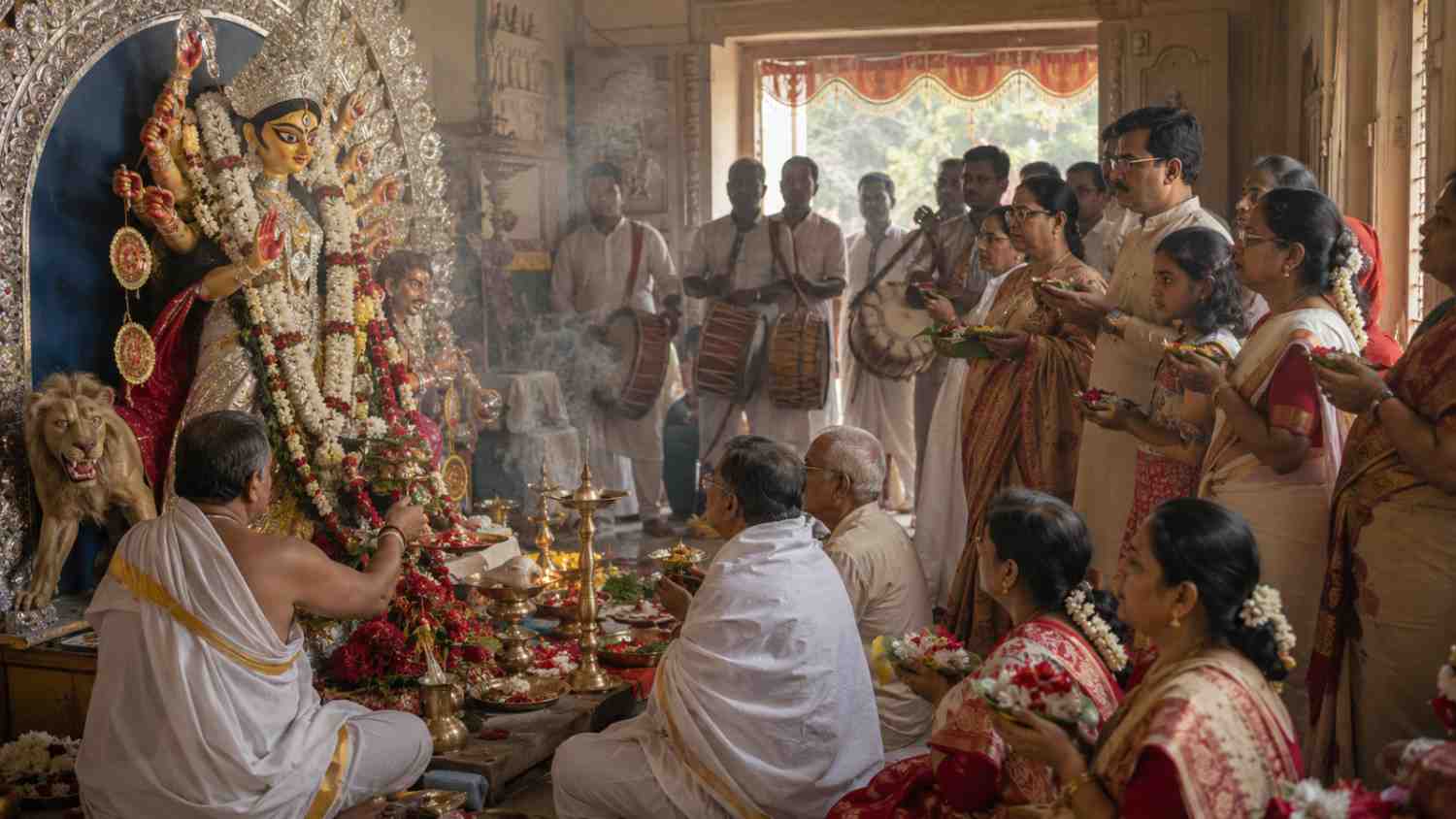
Durga Puja Rituals follow detailed religious procedures. Specific customs may vary between family pujas, temples, monasteries and community pandals.
Bodhan
Bodhan means awakening or invocation. It is usually performed on Shashthi to ceremonially welcome Goddess Durga into the sacred image and worship space.
The ritual establishes the transition from preparation to formal puja.
Nabapatrika
Nine sacred plants are tied together, bathed and placed near the image during Saptami. They symbolise different divine forms and also reflect the close relationship between sacred life, vegetation and agriculture.
Pushpanjali
Pushpanjali is the devotional offering of flowers. Worshippers hold flowers and leaves while repeating a mantra under the guidance of a priest.
Anjali is particularly popular on Ashtami, although it may be offered on other main worship days.
Kumari Puja
Kumari Puja honours the divine feminine in the form of a young girl. It expresses the belief that sacred power and dignity are present in living beings, not only in sculpted images.
The ritual is performed according to specific traditions and should be conducted respectfully, with the child’s comfort and wellbeing protected.
Sandhi Puja
Sandhi Puja is observed during the transition between Ashtami and Navami. It is performed at a precisely calculated time and may include special lamps, flowers and offerings.
Because of its ritual complexity, devotees should follow an authorised priest or established puja manual rather than relying on incomplete online instructions.
Dhunuchi Dance
A dhunuchi is an earthen incense burner traditionally filled with burning coconut husk, charcoal and aromatic material. During dhunuchi dance, participants move rhythmically while holding the vessel.
It is both a devotional offering and a recognisable cultural performance. Safety, ventilation and trained supervision are essential.
Sindoor Khela
Sindoor Khela takes place in many Bengali communities on Dashami. Married women traditionally apply vermilion to the Goddess and then to one another while praying for wellbeing.
Participation and interpretation vary. Modern organisers may adapt the custom to create a more inclusive environment, and no one should be pressured to participate.
Visarjan
Visarjan is the ritual immersion of the sacred image after farewell prayers. It represents the temporary physical form returning to nature while the divine presence remains eternal.
Environmentally responsible immersion practices, designated water bodies and non-toxic materials help protect rivers and local ecosystems.
Durga Puja in West Bengal
Durga Puja in West Bengal combines faith, art, public life and regional identity. It is celebrated in cities, small towns, villages, temples, family homes and neighbourhood clubs.
Kolkata
Kolkata is the most internationally recognised centre of Durga Puja. For several days, streets fill with visitors moving between pandals, traditional household pujas, food stalls and cultural events.
UNESCO identifies Kolkata as the festival’s major geographical and cultural centre, while Incredible India describes the city as a vast display of temporary artistic environments and illuminated streets.
Community Puja
Sarbojanin or community pujas are organised through local contributions, sponsorships and volunteer work. Committees coordinate worship, safety, lighting, crowd movement, cultural programmes and food distribution.
Many also organise:
- Blood-donation camps
- Community meals
- Clothing or food distribution
- Environmental awareness activities
- Children’s competitions
- Cultural performances
- Support for local artisans
Family Puja
Bonedi Bari or traditional family pujas often preserve older rituals, ancestral spaces and inherited customs. Their atmosphere may be more intimate than that of large theme pandals.
Visitors should respect household rules, photography restrictions and prayer spaces.
Art and Craft
Durga Puja supports a wide network of sculptors, bamboo workers, painters, textile artists, lighting experts, electricians, decorators, musicians and craftspeople.
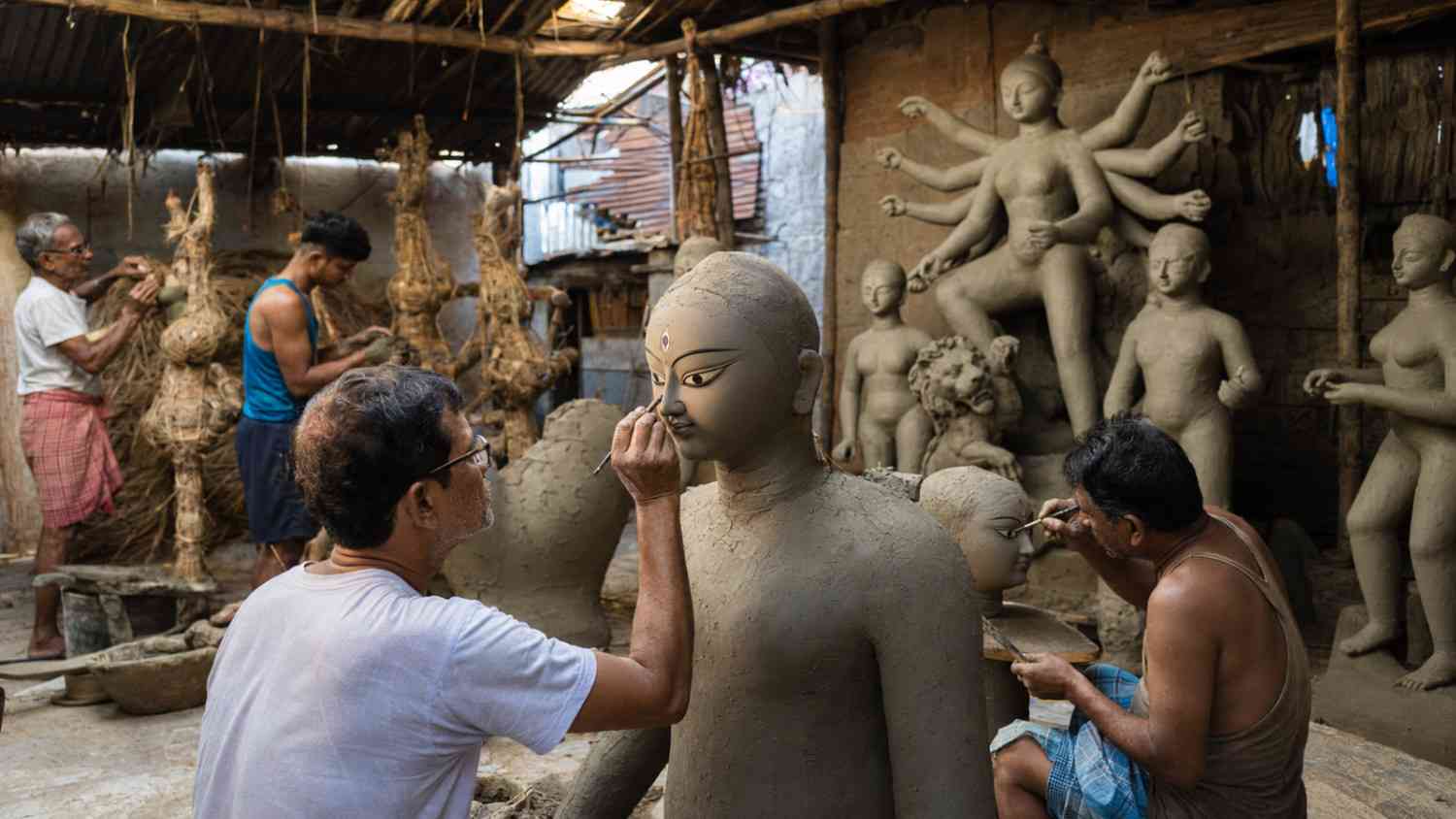
The image of Durga is often made from clay over a straw framework. The creative process may take months, while the finished form remains only temporarily before immersion. This cycle gives the festival a distinctive philosophy of creation, worship and return.
Famous Durga Puja Pandals
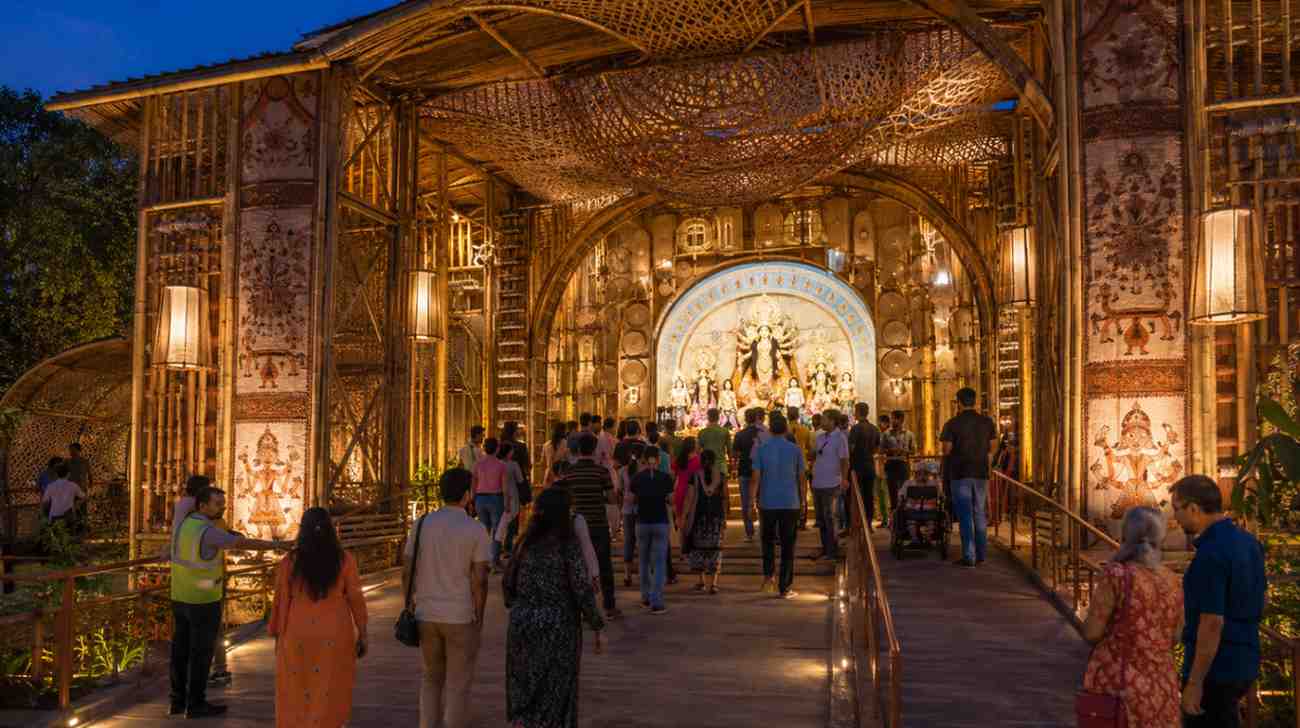
A Durga Puja Pandal is a temporary sacred and cultural structure built to house the image and enable community worship. Some follow traditional temple-inspired designs, while others use original themes and experimental materials.
An evergreen guide should not present a fixed list of “best pandals,” because themes, organisers and visitor experiences change every year.
Instead, pandals can be understood through broad styles:
Traditional Pandals
These emphasise classical Bengali imagery, familiar devotional decoration and traditional forms of the Goddess.
Theme Pandals
Theme pandals may explore folk art, literature, historic architecture, rural life, environmental concerns or social ideas.
Heritage Pujas
Old family homes and historic community pujas preserve long-established ritual styles and architectural settings.
Sustainable Pandals
Some organisers use bamboo, jute, clay, natural fibres and reusable materials to reduce environmental impact.
Pandals are important because they make art publicly accessible. People who may never enter a formal gallery can experience architecture, sculpture, lighting, sound and storytelling during a single evening of pandal hopping.
Environmental Awareness During Durga Puja
Durga Puja brings together devotion, art and community celebration, but large public events can also create waste, crowd pressure and water pollution. Environmentally responsible planning helps communities preserve the festival’s spiritual dignity while protecting rivers, neighbourhoods and public spaces.
Eco-Friendly Durga Idols
Traditional idols are generally created using bamboo, straw and natural clay. These materials are preferable because they are closer to Bengal’s inherited craftsmanship and break down more safely than synthetic alternatives.
Puja organisers should avoid idols made with plaster of Paris, plastic components or non-biodegradable decorative materials. Supporting skilled clay artisans also helps preserve the traditional knowledge associated with Durga idol-making.
Natural and Non-Toxic Colours
The paints and decorative coatings used on idols can enter water during immersion. Lead-based, chemical-heavy or metallic paints may harm aquatic life and reduce water quality.
Artisans and organisers should use water-based, natural or certified non-toxic colours wherever possible. Decorations made from cloth, paper, jute, bamboo, clay and plant fibres are also more environmentally responsible than plastic-heavy materials.
River Protection During Visarjan
Visarjan is a sacred farewell ritual, but it should be conducted in a way that minimises harm to rivers and lakes. Communities should follow local administrative rules and use designated immersion points or artificial immersion tanks where available.
Flowers, plastic ornaments, electrical items, metal frames and other decorations should be removed before immersion. Local authorities and puja committees can also arrange prompt collection of remaining materials from the water.
Devotees should never enter unsafe areas, overcrowd riverbanks or discard food containers and puja waste into natural water bodies.
Reducing Plastic Waste
Single-use plastic cups, plates, bottles, bags, banners and decorative sheets can create large amounts of waste during the festival. Puja committees can reduce this problem by choosing reusable steel utensils, clay cups, banana leaves, paper packaging and cloth bags.
Separate waste bins should be provided for:
- Food waste
- Recyclable material
- Flowers and biodegradable offerings
- General non-recyclable waste
Volunteers can place clear instructions near food counters, exits and community dining areas to encourage responsible disposal.
Sustainable Pandals and Decorations
Bamboo, cane, jute, cloth, clay, wood and reusable structural materials can be used to create beautiful pandals without depending heavily on plastic or thermocol. Lighting can also be planned efficiently by using energy-saving equipment and switching off unnecessary installations during quiet hours.
After the festival, organisers should dismantle pandals carefully and reuse or recycle as many materials as possible.
Responsible Participation by Visitors
Visitors also share responsibility for keeping Durga Puja clean and sustainable. They can carry reusable water bottles, avoid littering, use public transport when practical and respect designated waste-disposal areas.
Environmental awareness does not reduce the joy of Durga Puja. Instead, it reflects the festival’s deeper values of responsibility, harmony and respect for life.
Traditional Durga Puja Food
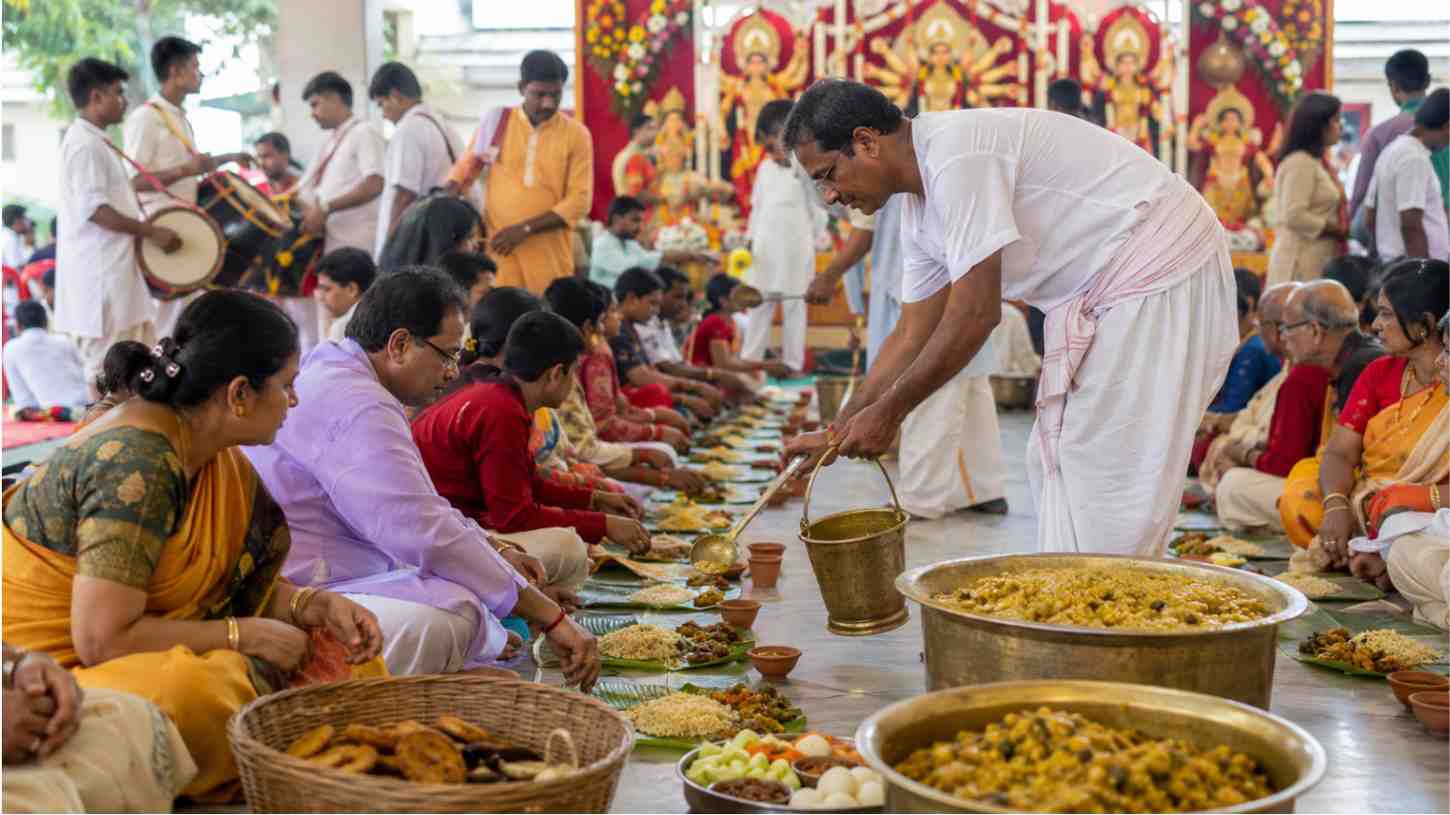
Food is central to Durga Puja Celebration because it brings worshippers, families and communities together.
Bhog Khichuri
Bhog khichuri is a comforting rice-and-lentil preparation offered to the Goddess and later distributed as prasad. It is generally vegetarian and prepared according to the customs of the puja.
Labra
Labra is a mixed vegetable dish commonly served with khichuri. Its ingredients vary by household and region.
Luchi and Vegetable Dishes
Luchi may be served at home with potato curry, cholar dal or other festive preparations. Some families prepare elaborate meals for visiting relatives.
Payesh
Payesh is made from rice, milk and sweetener. It is associated with auspicious occasions and may appear as part of bhog or a family meal.
Sweets
Sandesh, rasgulla, mishti doi and other Bengali sweets are shared during visits and Bijoya greetings.
Street and Restaurant Food
Pandal visitors also enjoy rolls, cutlets, chaat, biryani and regional Bengali dishes. These foods are part of the social festival experience rather than ritual bhog.
Food practices differ. Many public pujas serve vegetarian bhog, while some Bengali households prepare fish or meat during selected festival meals according to family tradition.
Music, Dance and Cultural Programmes
Dhak
The deep rhythm of the dhak is one of Durga Puja’s most recognisable sounds. Dhakis often travel from rural areas to perform in cities and community pandals.
Their music accompanies important rituals, processions and dhunuchi dance.
Dhunuchi Dance
Dhunuchi dance combines rhythm, devotion and visual movement. Participants perform individually or in groups as the dhak grows faster.
Cultural Evenings
Community pujas commonly organise:
- Bengali songs
- Classical and folk dance
- Drama
- Poetry recitation
- Children’s performances
- Quiz and drawing competitions
- Devotional music
- Bijoya Sammilani programmes
These events allow younger generations to learn language, music and performance while participating in community life.
Durga Puja Around the World
Durga Puja has travelled with Bengali communities across national borders. UNESCO recognises its presence among the Bengali diaspora as well as in India.
Bangladesh
Durga Puja is celebrated by Bengali Hindu communities across Bangladesh through temple and community worship. The festival carries both religious and Bengali cultural importance.
United Kingdom
Bengali cultural associations in Britain organise Durga Puja, religious worship, food and performances. Records from the UK Charity Commission show established Bengali organisations that include Durga Puja among their principal annual cultural and religious activities.
United States
Community associations in New York, California, Georgia and other regions organise worship and cultural programmes. Some celebrations take place over weekends so families can attend while maintaining the main rituals as closely as possible.
Canada
Bengali organisations in cities such as Winnipeg, Edmonton, Toronto and Montreal hold Durga Puja to preserve language, worship and community identity.
United Arab Emirates
Indian and Bengali expatriate communities in the Gulf maintain their cultural traditions through organised gatherings and religious activities, subject to local regulations and venue requirements. The UAE’s large Indian community provides an important setting for many regional cultural associations.
International celebrations may be shorter than those in Bengal, but they often perform an additional role: helping children growing up abroad connect with Bengali language, food, music and heritage.
Durga Puja Wishes
Durga Puja wishes express devotion, joy, courage, family affection and hope for peace. They may be shared with parents, relatives, friends, teachers, colleagues and social-media contacts.
A meaningful message should suit the recipient. A devotional wish may seek Maa Durga’s blessings, while a friendly greeting may focus on pandal visits, happiness and togetherness.
This pillar page does not reproduce a large collection because that would overlap with the dedicated cluster article. Readers looking for traditional, emotional, short and respectful greetings can explore Durga Puja Wishes in Bengali.
Durga Puja Quotes
Durga Puja quotes may focus on Shakti, courage, the victory of good over evil, motherhood or the cultural spirit of the festival.
Religious quotations should be handled carefully. A line should not be presented as a direct scriptural quotation unless its source can be verified. Modern inspirational lines and editorial reflections should be clearly distinguished from scripture.
A dedicated Durga Puja Quotes in Bengali article can provide a broader, properly organised collection for students, devotees and social-media users.
Durga Puja Caption
A Durga Puja caption is usually shorter and more visual than a wish or quotation. It may accompany photographs of pandals, traditional clothing, dhunuchi dance, family gatherings, bhog or festive city streets.
Good captions are natural, brief and relevant to the photograph. Readers can find short, stylish, devotional and cultural options in the dedicated Durga Puja Caption collection.
Durga Puja Status
Durga Puja status messages are commonly used on WhatsApp, Facebook and other social platforms. They may announce the arrival of the festival, express devotion or share Bijoya greetings.
Status content should remain respectful, especially when it includes the Goddess’s name, sacred imagery or mantra-like wording. A dedicated Durga Puja Status Bengali guide can organise short messages according to mood and occasion.
Durga Puja Mantra
A Durga Puja mantra is a sacred sound, verse or prayer recited in devotion to Goddess Durga. Mantras may be used for worship, meditation, protection or the expression of surrender.
Correct pronunciation, intention and ritual context are important. Readers should learn sacred recitations from a qualified priest, teacher or reliable scripture rather than depending solely on decorative social-media posts.
The dedicated Durga Puja Mantra article can explain selected mantras with Devanagari or Bengali script, transliteration, meaning and respectful usage guidance.
Durga Puja Anjali Mantra
The Durga Puja Anjali Mantra is recited while devotees offer flowers during Pushpanjali. A priest normally leads the recitation, allowing participants to repeat each line.
Because pronunciation and ritual sequence matter, the full mantra should appear in a dedicated, carefully reviewed resource. The Durga Puja Anjali Mantra article can provide the text, transliteration, Bengali meaning and step-by-step etiquette without crowding this broader guide.
Durga Puja Samagri
Durga Puja samagri means the materials required for worship. The exact list depends on the day, ritual, regional tradition and instructions of the priest.
Common categories may include:
- Flowers and leaves
- Fruits and sweets
- Incense and lamps
- Sacred vessels
- Cloth and decorative items
- Ingredients for bhog
- Items for homa
- Materials for anjali
- Nabapatrika plants
- Offerings used during specific rituals
A household worship list may be much shorter than the materials required for a full community puja. Readers should consult the dedicated Durga Puja Samagri guide and confirm the final list with their priest.
Interesting Facts About Durga Puja
- Durga Puja in Kolkata entered UNESCO’s Representative List of the Intangible Cultural Heritage of Humanity in 2021.
- The festival is described as a ten-day worship period, although Shashthi to Dashami form the most visible public phase.
- Many idols are built over straw frameworks using unfired clay.
- Pandal construction can involve architects, sculptors, painters, lighting specialists, craftspeople and sound designers.
- Theme pandals function as temporary public-art installations.
- Durga is commonly depicted defeating Mahishasura while accompanied in Bengal by Lakshmi, Saraswati, Ganesha and Kartikeya.
- Mahalaya creates the emotional beginning of the festival, but the formal public worship begins later.
- The Nabapatrika consists of nine plants and is more complex than the popular description of Kola Bou as only a banana plant.
- Dhakis often travel from villages to towns and cities for seasonal performances.
- Durga Puja supports a large ecosystem of temporary and permanent work connected with art, food, transport, clothing and hospitality.
- The sacred image is worshipped for only a limited period before immersion, expressing the cycle of creation, presence and return.
- Bengali communities abroad use Durga Puja to teach younger generations language, music, rituals and cultural identity.
Frequently Asked Questions
Durga Puja is a major Hindu festival honouring Goddess Durga and commemorating her victory over Mahishasura. It combines worship, community celebration, art, music and food.
It is celebrated to honour divine feminine power and the victory of good over evil. Devotees also welcome Durga as the compassionate Mother and seek courage, protection and wellbeing.
The central sacred narrative describes Goddess Durga confronting and defeating Mahishasura, whose uncontrolled power had disturbed cosmic and moral order.
The wider religious observance is associated with a ten-day period. In Bengal, the main public rituals and celebrations are especially prominent from Shashthi to Vijayadashami.
Mahalaya announces the beginning of Devi Paksha and prepares the spiritual atmosphere for the Goddess’s arrival. The main formal public worship generally begins on Shashthi.
Both honour the divine feminine and occur during the same sacred season. Navaratri is observed through diverse regional traditions, while Bengali Durga Puja places special emphasis on the image of Durga, community pandals and the rituals from Shashthi to Dashami.
There is no single answer because the rituals form an interconnected sequence. Bodhan, Pushpanjali, Sandhi Puja, the main daily worship and Vijayadashami all carry special importance.
Pushpanjali is the devotional offering of flowers while repeating a mantra led by the priest. Ashtami anjali is especially popular.
Sandhi Puja marks the sacred transition between Ashtami and Navami and remembers a decisive moment in the Goddess’s victory over destructive forces.
Sindoor Khela is a Dashami custom in which married women traditionally offer and apply vermilion before the Goddess’s farewell. Practices and participation vary among communities.
The Goddess is offered farewell prayers, and the image is taken for Visarjan. People then exchange Shubho Bijoya greetings, seek elders’ blessings and share sweets.
Pandals are temporary worship and art spaces. They may display traditional craftsmanship, experimental themes, historic architecture or environmentally conscious design.
Common public bhog includes khichuri, labra, vegetable preparations, chutney, payesh and sweets. Household and restaurant meals may include many additional Bengali dishes.
UNESCO recognised Durga Puja in Kolkata as a living cultural heritage combining religious practice, clay-image making, temporary architecture, art, performance and community participation.
Yes. Bengali communities celebrate it in Bangladesh and in countries such as the UK, USA and Canada, as well as in other parts of the global diaspora.
Yes. Most community pandals welcome visitors, but tourists should follow queue systems, dress respectfully, avoid blocking worshippers and ask before photographing private rituals or individuals.
Conclusion
Durga Puja is a profound meeting point of devotion, mythology, family emotion, art and community life. At its spiritual centre stands Goddess Durga’s victory over Mahishasura—a timeless reminder that courage guided by wisdom can overcome injustice and destructive power.
The festival also reflects Bengal’s extraordinary ability to transform worship into shared cultural experience. Clay artisans, priests, dhakis, designers, cooks, volunteers and visitors all contribute to an event that is recreated with fresh energy every year.
Its UNESCO recognition confirms the global cultural value of this living heritage, but its deepest meaning continues to reside in prayer, community cooperation and the relationship between the devotee and the Divine Mother.
By celebrating responsibly, supporting traditional artisans, reducing waste and respecting different customs, communities can preserve the religious and cultural dignity of Durga Puja for future generations.
Why Trust HuntBliss?
HuntBliss creates structured, evergreen and reader-focused guides that separate verified cultural information from mythology, symbolism and editorial interpretation.
This article was reviewed for religious sensitivity, factual consistency and clear distinction between widely observed traditions and customs that may vary by family, institution or region. Important heritage claims were checked against UNESCO, Incredible India, the West Bengal Heritage Repository and recognised museum resources.
The purpose is not to replace a priest, scripture or local tradition, but to help students, devotees, tourists and international readers understand Durga Puja accurately and respectfully.
Trusted sources & references
The historical, religious, cultural and UNESCO-related information in this Durga Puja guide was checked using the following authoritative sources:
UNESCO Intangible Cultural Heritage – Durga Puja in Kolkata
https://ich.unesco.org/en/RL/durga-puja-in-kolkata-00703
Official information about Durga Puja’s 2021 inscription, clay-image craftsmanship, pandal art, rituals and community participation.
Incredible India – Durga Puja: A Celebration of Devotion and Art
https://www.incredibleindia.gov.in/en/festivals-and-events/durga-puja
Government tourism information covering the festival’s traditions, artistic pandals, public celebrations and visitor experience.
The Metropolitan Museum of Art – Hinduism and Hindu Art
https://www.metmuseum.org/essays/hinduism-and-hindu-art
A recognised museum resource for understanding Goddess Durga, Shakti, Hindu iconography and the symbolism of Durga’s victory over Mahishasura.
West Bengal Heritage Repository
https://tetsd.wb.gov.in/heritage/
Government of West Bengal heritage resource covering the state’s living cultural traditions and the significance of Durga Puja as intangible heritage.
Sahapedia – Durga Puja
https://www.sahapedia.org/durga-puja
A cultural knowledge resource explaining the festival’s ten-day framework, Bengali traditions, rituals and historical development.
## Relevant Articles
Explore our detailed Durga Puja guides to learn more about rituals, traditions, wishes, mantras, food, and festive celebrations:
- Mahalaya Wishes in Bengali — heartfelt Bengali wishes, greetings, messages, and WhatsApp status for Mahalaya.
- Mahalaya Quotes in Bengali — inspirational, devotional, and Agomoni-themed Bengali quotes.
- Durga Puja Wishes in Bengali — beautiful greetings and festive messages for family, friends, and loved ones.
- Durga Puja Quotes in Bengali — meaningful devotional and motivational quotes celebrating Maa Durga.
- Durga Puja Caption in Bengali — trendy Bengali captions for Facebook, Instagram, and social media.
- Durga Puja Status in Bengali — short and engaging WhatsApp and Facebook status updates.
- Durga Mantra in Bengali — Durga Pranam Mantra, Pushpanjali Mantra, and other devotional chants with meanings.
- Durga Puja Samagri — complete list of Durga Puja items, their significance, and preparation guide.
- Durga Puja Decoration Ideas — creative decoration ideas for homes, pandals, offices, and festive spaces.
- Durga Puja Bhog — traditional Bengali bhog menu, khichuri recipes, and sacred food offerings.
- Durga Puja Anjali Mantra — complete Pushpanjali Mantra with Bengali text, pronunciation, meaning, and offering procedure.