Choosing among modern muslim girl names is not simply about finding names that were invented recently. Many established Arabic, Persian and other Muslim-use names continue to work naturally for contemporary families because they combine clear meanings with practical pronunciation, manageable spelling and everyday usability. Parents may also consider family familiarity, linguistic origin, international use and personal preference before creating a final shortlist.
For readers who want a wider selection beyond the contemporary focus of this article, HuntBliss also offers a broader Muslim girl-name collection covering additional naming styles and traditions.
📖 Quick Summary
- The complete article contains 80 distinct underlying names.
- Part 1A presents the first 40 names across two contemporary-use categories.
- Meanings and origins are kept concise and cautiously verified.
- Arabic or other original-script forms are included where appropriate.
- Roman spelling variants are not counted as separate names.
- In this guide to modern muslim girl names, “modern” refers to present-day suitability rather than necessarily recent invention.
📚 Table of Contents
What Makes a Muslim Girl Name Feel Modern Today?
The phrase modern muslim girl names describes contemporary naming suitability rather than the historical age of a name. A centuries-old name can still work naturally today when its pronunciation, spelling, rhythm and everyday use fit comfortably within present-day family and social settings.
Some parents prefer concise names that travel easily between languages. Others value a fluid sound, an established meaning, a familiar family connection or a Roman spelling that is unlikely to create constant correction. No single feature makes a name modern by itself; the overall combination matters more.
Likewise, appearing on a current baby-name website is not evidence that a name is linguistically new or genuinely fashionable. This collection therefore avoids unsupported claims such as “fastest-rising,” “trending in 2026” or “most popular today.” Established names remain eligible when they continue to function well as contemporary choices.
How This Contemporary Name Collection Was Selected and Verified
The collection was built at the underlying-name level. Ordinary transliteration differences are treated as variants rather than as extra names, while genuinely different linguistic forms are kept separate. This prevents the total from being inflated through alternate Roman spellings.
Meanings were checked conservatively. Arabic entries use defensible Arabic lexical senses, while Persian or other linguistic origins are retained where appropriate instead of relabelling every Muslim-use name as Arabic. A name may be widely used by Muslim families without being Arabic in etymological origin.
Religious status is also kept separate from linguistic meaning. Muslim use does not automatically make a name Quranic, and the occurrence of an Arabic word in Quranic text does not by itself make that word a recommended personal name. This article is about contemporary naming suitability, not Quranic classification or religious ranking.
Roman spellings can also vary legitimately. Forms such as Noor/Nur, Hiba/Heba and Yasmin/Yasmeen may represent the same underlying name, while visually similar English spellings can sometimes hide different original-language forms. The cards therefore mention variants only where they help readers understand the name more accurately.
80 Contemporary Muslim Girl Names and Meanings
The complete collection of 80 modern muslim girl names is arranged around practical contemporary qualities rather than alphabetically. Part 1A presents names #1–#40: first, short and practical choices; then softer and more elegant contemporary forms. The categories are browsing aids, not claims of popularity or superiority.
Short & Practical Contemporary Choices
These names are generally concise, straightforward to pronounce or easy to carry into everyday use. For families comparing modern muslim girl names, this group offers practical starting points without suggesting that every short name is automatically modern.
#1 Noor — نور
Meaning: Light. Origin: Arabic. Variant: Nur. Cross-gender, with strong female use; its compact form works easily across many settings.
#2 Huda — هدى
Meaning: Guidance. Origin: Arabic. Variant: Houda. Short, established and straightforward in everyday use.
#3 Hiba — هبة
Meaning: Gift. Origin: Arabic. Variant: Heba. Its two-syllable form and simple spelling suit contemporary use well.
#4 Hana — هناء
Meaning: Happiness, bliss. Origin: Arabic. Variant: Hanaa where Arabic Hanāʾ is intended. Roman Hana also represents unrelated names in other languages.
#5 Aya — آية
Meaning: Sign; verse. Origin: Arabic. Variant: Ayah. Very concise and easy to recognize across several linguistic environments.
#6 Dua — دعاء
Meaning: Supplication, prayer. Origin: Arabic. Variants: Du’a, Duaa. A compact established form with simple everyday pronunciation.
#7 Reem — ريم
Meaning: White gazelle or antelope. Origin: Arabic. Variant: Rim where the same Arabic form is intended. Its short Roman spelling is practical and distinctive.
#8 Salma — سلمى
Meaning: Safe. Origin: Arabic. Familiar, concise and well suited to contemporary use without expanding the meaning into unsupported spiritual interpretations.
#9 Sara — سارة
Meaning: Princess; noble lady. Origin: Hebrew/Semitic; widely used by Muslim families. Variant: Sarah. Its broad cross-cultural familiarity makes it practical for multilingual families.
#10 Amal — أمل
Meaning: Hope. Origin: Arabic. Amal is cross-gender in some communities and has a concise Roman form suited to everyday use.
#11 Farah — فرح
Meaning: Joy, happiness. Origin: Arabic. Familiar across several regions and straightforward to pronounce.
#12 Haya — حياء
Meaning: Modesty, bashfulness. Origin: Arabic. A compact form with an established lexical meaning and uncomplicated daily use.
#13 Nida — نداء
Meaning: Call, appeal. Origin: Arabic. Variant: Nidaa. Short and relatively easy to pronounce across languages.
#14 Maha — مها
Meaning: Oryx. Origin: Arabic. Traditional poetic associations with striking eyes should not replace the core lexical meaning.
#15 Sana — سناء
Meaning: Radiance, brilliance. Origin: Arabic. Variant: Sanaa where the same Arabic form is intended. Compact and familiar in Roman spelling.
#16 Ruba — رُبى
Meaning: Highlands, hills. Origin: Arabic. Variant: Rouba. A concise and distinctive choice with a simple sound pattern.
#17 Dima — ديمة
Meaning: Steady gentle rain. Origin: Arabic. Variant: Deema. The short, fluid pronunciation gives it practical contemporary appeal.
#18 Muna — منى
Meaning: Wishes, desires. Origin: Arabic. Variant: Mona only where Arabic منى is genuinely intended. Short and familiar across several communities.
#19 Nada — ندى
Meaning: Dew; also generosity. Origin: Arabic. A concise form that remains easy to use in multilingual environments.
#20 Nawal — نوال
Meaning: Gift; benefit or favor. Origin: Arabic. An established name whose clean pronunciation remains practical for contemporary families.
Soft & Elegant Contemporary Names
This group emphasizes flowing pronunciation, balanced forms and established meanings. The category describes how the names function as present-day choices rather than claiming that they are newly created or universally fashionable.
#21 Inaya — عناية
Meaning: Care, concern, attention. Origin: Arabic. Variant: Inaaya. Its flowing pronunciation and familiar spelling support easy everyday use.
#22 Rania — رانية
Meaning: One who gazes or looks attentively. Origin: Arabic. Variant: Ranya where the same form is intended. Smooth pronunciation gives it broad contemporary usability.
#23 Aaliyah — عالية
Meaning: High, lofty, elevated. Origin: Arabic. Variants: Aliyah, Aaliya only when representing عالية. Unrelated Alia or Aliya forms should not be merged automatically.
#24 Amira — أميرة
Meaning: Female leader; princess. Origin: Arabic. Variant: Ameera. Familiar pronunciation and a clear feminine form support contemporary use.
#25 Anisa — أنيسة
Meaning: Friendly, companionable. Origin: Arabic. Variant: Aneesa. Soft in sound while retaining a clear established meaning.
#26 Basma — بسمة
Meaning: Smile. Origin: Arabic. Variant: Basmah. Short, easy to pronounce and uncomplicated in Roman spelling.
#27 Bushra — بشرى
Meaning: Good news, glad tidings. Origin: Arabic. Variant: Boshra. An established form with a concise, defensible meaning.
#28 Jamila — جميلة
Meaning: Beautiful. Origin: Arabic. Variant: Jameela. Familiar across many Muslim communities and relatively easy to pronounce.
#29 Karima — كريمة
Meaning: Generous, noble. Origin: Arabic. Variant: Kareema. An established name with a clear meaning and smooth pronunciation.
#30 Latifa — لطيفة
Meaning: Gentle, kind. Origin: Arabic. Variant: Lateefa. A long-established name that remains practical in present-day family use.
#31 Munira — منيرة
Meaning: Luminous, bright. Origin: Arabic. Variant: Muneera. Its clear meaning and rhythmic pronunciation suit contemporary naming preferences.
#32 Naila — نائلة
Meaning: One who attains or acquires. Origin: Arabic. Variant: Nayla where the same Arabic form is intended. Easy syllable structure supports international use.
#33 Naima — نعيمة
Meaning: Comfortable, at ease. Origin: Arabic. Variant: Naeema. A soft established form with a manageable Roman spelling.
#34 Samira — سميرة
Meaning: Female evening companion; conversational companion. Origin: Arabic. Variant: Sameera. Widely recognizable and easy to carry across regions.
#35 Wafa — وفاء
Meaning: Loyalty, faithfulness. Origin: Arabic. Variant: Wafaa. Short and distinctive, with an established lexical meaning.
#36 Yasmin — ياسمين
Meaning: Jasmine. Origin: Persian origin; widely transmitted into Arabic and Muslim naming. Variant: Yasmeen. Its broad familiarity supports easy cross-cultural use.
#37 Areej — أريج
Meaning: Fragrance, scent. Origin: Arabic. Variant: Arij. Distinctive without requiring an unusually complicated Roman spelling.
#38 Hala — هالة
Meaning: Halo. Origin: Arabic. Its compact spelling and straightforward pronunciation make it practical in contemporary use.
#39 Lubna — لبنى
Meaning: Storax tree. Origin: Arabic. Variant: Lubnah. An established literary-sounding form that remains usable today.
#40 Manal — منال
Meaning: Attainment, achievement. Origin: Arabic. Clear spelling and an established positive lexical sense support contemporary use.
Contemporary Names With Strong Established Meanings
For parents comparing modern muslim girl names, this category focuses on established names whose meanings remain clear and defensible while their pronunciation, spelling, or everyday usability still works naturally in contemporary family settings.
#41 Adila — عادلة
Meaning: Just, fair. Origin: Arabic. Variant: Adeela.
#42 Afaf — عفاف
Meaning: Chastity, modesty. Origin: Arabic.
#43 Aziza — عزيزة
Meaning: Dear, precious. Origin: Arabic.
#44 Faiza — فائزة
Meaning: Successful, victorious. Origin: Arabic. Variant: Faizah.
#45 Habiba — حبيبة
Meaning: Beloved. Origin: Arabic. Variant: Habeeba.
#46 Ibtisam — ابتسام
Meaning: Smile. Origin: Arabic. Variant: Ebtisam.
#47 Kamila — كاملة
Meaning: Complete, perfect. Origin: Arabic.
#48 Mahira — ماهرة
Meaning: Skilled, expert. Origin: Arabic. Variant: Maheera.
#49 Najwa — نجوى
Meaning: Private conversation, secret counsel. Origin: Arabic. Variant: Najwah.
#50 Sakina — سكينة
Meaning: Tranquillity, calmness. Origin: Arabic. Variants: Sakinah, Sakeena.
#51 Shakira — شاكرة
Meaning: Thankful, grateful. Origin: Arabic. Variant: Shakirah.
#52 Tahira — طاهرة
Meaning: Pure. Origin: Arabic. Variant: Tahirah.
#53 Taqwa — تقوى
Meaning: Piety, God-consciousness. Origin: Arabic.
#54 Shifa — شفاء
Meaning: Healing, cure. Origin: Arabic. Variant: Shifaa.
#55 Safiya — صفية
Meaning: Chosen, favored, or beloved companion. Origin: Arabic. Variants: Safiyya, Safia. Historic and established, with a concise form that remains practical as a contemporary choice.
#56 Zahira — زاهرة
Meaning: Radiant, shining. Origin: Arabic. Variant: Zahirah.
#57 Saliha — صالحة
Meaning: Righteous, virtuous. Origin: Arabic. Variant: Salihah.
#58 Sabira — صابرة
Meaning: Patient, steadfast. Origin: Arabic. Variant: Sabirah.
#59 Rashida — رشيدة
Meaning: Rightly guided; sensible or mature. Origin: Arabic. Variant: Rashidah.
#60 Hakima — حكيمة
Meaning: Wise. Origin: Arabic. Variant: Hakimah.
Distinctive & Cross-Regional Modern Choices
The final group widens the linguistic range beyond Arabic alone. It includes Turkish, Persian, Persian-Urdu and cross-regional forms alongside Arabic names, while keeping etymological origin separate from later Muslim-community usage.
#61 Deniz
Meaning: Sea. Origin: Turkish. Cross-gender in Turkish naming use.
#62 Derya
Meaning: Sea, ocean. Origin: Turkish form derived from Persian daryā. Cross-gender in some naming contexts.
#63 Lale
Meaning: Tulip. Origin: Turkish, from Persian lāle. Persian Laleh is a related regional form rather than an automatic Roman spelling variant.
#64 Nasreen — نسرین
Meaning: A type of rose or wild rose. Origin: Persian. Variant: Nasrin.
#65 Parveen — پروین
Meaning: The Pleiades. Origin: Persian. Variants: Parvin, Perveen. Some cross-gender use occurs across regional naming traditions.
#66 Shabnam — شبنم
Meaning: Dew. Origin: Persian.
#67 Mahnoor — ماہ نور
Meaning: Moonlight. Origin: Persian-Urdu compound. Variant: Mahnur where the same compound is intended.
#68 Sadaf — صدف
Meaning: Seashell, mother-of-pearl. Origin: Arabic lexical origin; established Persian and Urdu personal-name use.
#69 Sahar — سَحَر
Meaning: Pre-dawn time. Origin: Arabic. The intended form is سَحَر and should not be confused with differently vocalized Arabic words that may look similar in Roman script.
#70 Nargis — نرگس
Meaning: Narcissus flower. Origin: Persian usage. Variant: Narges.
#71 Niloufar — نیلوفر
Meaning: Water lily. Origin: Persian. Variant: Nilufar.
#72 Roya — رویا
Meaning: Dream. Origin: Arabic lexical origin; established Persian personal-name use. Its short, clean form suits contemporary use well.
#73 Ilham — إلهام
Meaning: Inspiration. Origin: Arabic. Cross-gender in some naming traditions.
#74 Maysa — ميساء
Meaning: One who walks with an elegant, swaying gait. Origin: Arabic.
#75 Hadeel — هديل
Meaning: Cooing of a dove or pigeon. Origin: Arabic. Variant: Hadil.
#76 Dalia — دالية
Meaning: Grapevine; vine shoot. Origin: Arabic form intended. It should not automatically be equated with every international name spelled Dalia.
#77 Rasha — رشا
Meaning: Young gazelle. Origin: Arabic.
#78 Rayhana — ريحانة
Meaning: Sweet basil; fragrant plant. Origin: Arabic. Variant: Rehana where the same underlying form is intended.
#79 Warda — وردة
Meaning: Rose, flower. Origin: Arabic. Variant: Wardah.
#80 Abeer — عبير
Meaning: Fragrance. Origin: Arabic. Variant: Abir where the same Arabic form is intended.
How to Choose a Modern Name That Works in Everyday Life
When comparing modern muslim girl names, it helps to move beyond appearance on a list and consider how each option will actually work in everyday life. A practical choice usually combines a meaning you are comfortable with, a pronunciation your family can use naturally, and a Roman spelling that can be written consistently.
Say each shortlisted name aloud in the languages commonly spoken at home. A name may look simple on paper but be pronounced very differently across Arabic, Urdu, Bengali, Turkish, Persian or English-speaking environments. That is not necessarily a problem, but it is worth noticing before making a final decision.
Consider whether the name feels familiar enough for your family while still matching your contemporary preferences. Some parents prefer very short forms, while others are comfortable with longer established names if the pronunciation remains clear and the spelling is manageable.
It is also useful to verify the lexical meaning and linguistic origin instead of relying on a website’s claim that a name is “trending,” “stylish” or “popular.” Those labels can change quickly and are often presented without data. Long-term practicality usually matters more than a temporary online description.
Pronunciation, Roman Spelling & Cross-Regional Use

Roman spellings are not always fixed. Arabic, Persian and other scripts can be represented in English letters in several reasonable ways, so one underlying name may appear in more than one form. Safiya, Safiyya and Safia, for example, can represent the same Arabic name, just as Nasreen and Nasrin can represent the same Persian form.
Variants should therefore not automatically be counted as separate names. Parveen, Parvin and Perveen illustrate the same principle, while Abeer and Abir can represent the same Arabic form. Rayhana and Rehana may likewise overlap when they refer to the same underlying Arabic name.
For modern muslim girl names, consistent spelling becomes especially useful when families live across different linguistic environments. Choosing one preferred Roman form for school, travel and official documents can reduce unnecessary confusion without implying that alternative transliterations are incorrect.
At the same time, similar spellings do not always mean identical linguistic histories. Turkish Lale and Persian Laleh are closely related regional forms, but one should not treat every difference as a simple Roman-letter substitution. Derya is used in Turkish but derives historically from Persian daryā. Roya is established in Persian personal naming while its lexical history should still be described carefully rather than reduced to a simplistic single-language label.
Can a Traditional Name Still Feel Modern?
Yes. The historical age of a name and its contemporary usability are different questions. A name can have centuries of history and still fit comfortably into present-day family life.
Names such as Safiya, Samira, Salma or Huda do not need to be newly created to function as current choices. Concise forms, familiar pronunciation, manageable Roman spellings and continued regional or international use can all contribute to present-day practicality.
The same principle works in reverse: a short or recently promoted name is not automatically more modern in any meaningful linguistic sense. A useful contemporary choice should still have a defensible identity, meaning and origin.
Building a Final Shortlist
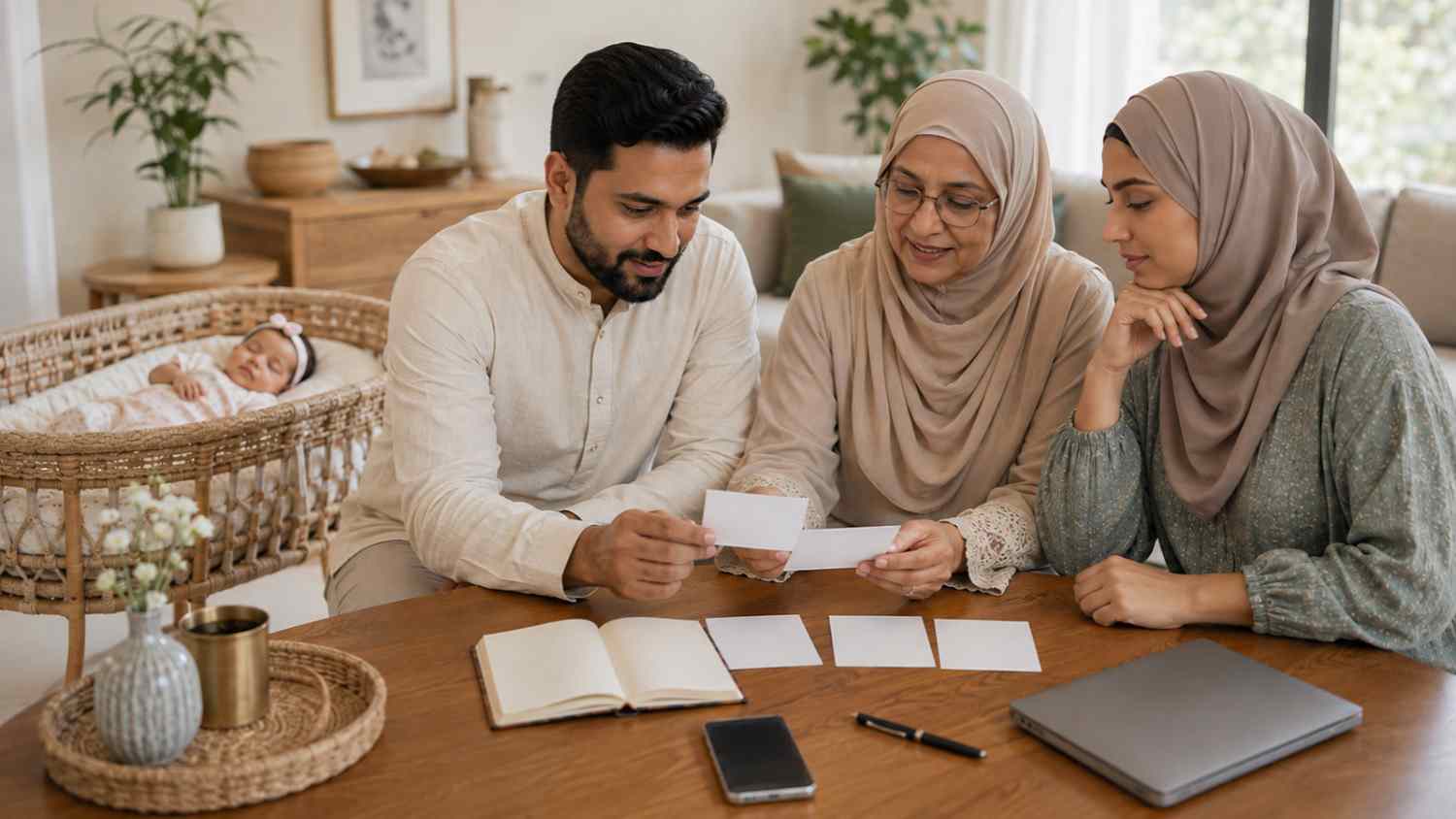
After browsing the full collection, reduce the list to three to five serious possibilities. A shorter shortlist makes comparison easier and encourages more careful discussion.
- Say every name aloud several times.
- Try it with the child’s surname or family name.
- Check whether close family members can pronounce it comfortably.
- Choose a consistent Roman spelling.
- Verify the meaning and linguistic origin before finalizing it.
- Consider how the name will function across the languages your family regularly uses.
- Avoid choosing solely because a website labels a name “trending.”
Where two spellings represent one underlying name, compare the spellings rather than treating them as two separate naming options. Where two similar-looking forms come from different languages or lexical histories, check the original form before combining them.
Frequently Asked Questions
Contemporary usability can come from a manageable spelling, clear pronunciation, concise or fluid sound, cross-language practicality and continued relevance in everyday family life. It does not require the name to have been invented recently.</p>
No. Muslim naming traditions include Arabic, Persian, Turkish, Urdu and other linguistic influences. A name’s widespread use among Muslim families does not automatically make its etymological origin Arabic.</p>
Say the name aloud in the languages most commonly used by your family, check whether important sounds change substantially, and consider whether the Roman spelling communicates the intended pronunciation reasonably well. Perfect uniformity across languages is not necessary.
No. Quranic occurrence and contemporary Muslim naming use are separate matters. A name can be well established among Muslim families without appearing as a personal name in Quranic text, while a Quranic word is not automatically a recommended personal name merely because it occurs there.
Conclusion
The most useful way to compare modern muslim girl names is to balance contemporary usability with factual care. Meaning, linguistic origin, pronunciation, Roman spelling, family context and long-term practicality all deserve attention. A name does not need to be newly invented to feel current; it needs to work naturally for the family choosing it while retaining a defensible identity and meaning.
Why Trust HuntBliss for This Name Collection?
This collection was built around 80 distinct underlying names rather than inflated through ordinary spelling variants. Where different Roman forms represent the same name, they are presented as variants instead of separate entries.
Dubious discovery candidates were excluded when their meanings or origins could not be defended confidently. Arabic, Persian, Turkish and regional naming histories were also kept distinct rather than treating every Muslim-use name as Arabic.
The editorial definition of “modern” is based on contemporary usability—such as pronunciation, spelling and everyday practicality—not unsupported claims about popularity, rankings or current trends.
Editorial, Linguistic & Cultural Accuracy Note
Muslim naming traditions differ across languages, countries and families. A name widely used by Muslims may have Arabic, Persian, Turkish, Hebrew/Semitic or another linguistic origin.
Roman spellings also vary legitimately, particularly when names move between Arabic-script languages and English. Meanings can be oversimplified online, so this article uses concise lexical descriptions rather than decorative interpretations.
The word “modern” in this collection refers to present-day naming suitability. It does not mean that every name is recently invented, nor does inclusion rank a name by religiosity, spiritual value or religious preference.
External Sources & Further Reading
- Lane’s Arabic-English Lexicon — classical Arabic lexical meanings and root-based reference.
- Hans Wehr, A Dictionary of Modern Written Arabic — established Arabic vocabulary and forms.
- Arabic Language Academy and established Arabic dictionaries — additional lexical verification for Arabic words and grammatical forms.
- Steingass, A Comprehensive Persian-English Dictionary — Persian vocabulary and etymological reference.
- Dehkhoda Dictionary and Mo’in Persian Dictionary — Persian lexical and usage references.
- Encyclopaedia Iranica — academic background on Persian language, culture and established names.
- Türk Dil Kurumu — authoritative Turkish vocabulary and linguistic reference.
Related Muslim Girl Name Articles
Looking beyond contemporary-style choices? These related HuntBliss collections can help you explore Muslim girl names from broader, Quran-focused, and letter-specific perspectives:
- Muslim Girls Name — return to the main collection for a broader overview of Muslim girl naming options.
- Islamic Baby Girl Names from Quran — explore names and naming terms with carefully explained Quranic connections.
- Muslim Girl Names Starting With S — compare S-starting names, their meanings, origins, and spelling variants.
- Muslim Baby Girl Names — browse more Muslim baby girl names beyond the modern-focused collection.