Parents looking for muslim girl names starting with b often find familiar Arabic names alongside regional spellings, literary traditions, and names whose Quranic connection is easy to overstate. This collection has been curated by checking actual female use, meaning, linguistic origin, source spelling, transliteration, regional usage, duplicate variants, and relevant Quranic or historical claims. Not every name here is Arabic, and not every name with an Arabic root should be described as a Quranic personal name.
For a broader collection beyond one initial letter, see our Muslim Girl Names hub.
📖 Quick Summary
- The complete article contains 28 carefully reviewed names; Part 1A covers #1–#14, while Part 1B will cover #15–#28.
- This guide to muslim girl names starting with b includes names connected with Arabic, Persian, Urdu/South Asian, Turkish, and other regional Muslim naming traditions.
- Spelling and transliteration variants are consolidated when they represent the same underlying name rather than being counted as separate entries.
- Exact Quranic vocabulary is distinguished from names that are only root-related or associated with later Islamic tradition.
- Some names are cross-gender or region-sensitive, so usage notes matter as much as literal meaning.
- Where etymology is uncertain, the meaning is stated conservatively rather than replaced with a decorative interpretation.
📚 Table of Contents
spelling-transliteration Spelling, Transliteration & Variant Method

Roman spellings can vary because Arabic, Persian, Urdu/South Asian usage, Turkish transmission, French/Maghrebi Romanization, and different ways of representing vowels do not always produce one universal English form. In muslim girl names starting with b, forms such as Bushra/Boshra/Bouchra, Batul/Batool, Basima/Basimah, Buthayna/Buthaina, and Bilqis/Balqis may represent the same underlying name identity, so they are consolidated rather than counted as separate names.
Visual similarity in Roman letters, however, is not enough to merge names. Basma is not Basima: Basma is the noun “smile,” while Basima is a feminine participial or adjectival form meaning “smiling.” Likewise, Badi’a — بديعة is not Badiya — بادية. A plain Roman spelling such as “Badia” should not be normalized without confirming the source form.
28 B-Starting Muslim Girl Names With Meanings
Familiar & Well-Established B-Starting Muslim Girl Names
This first group of muslim girl names starting with b focuses on established naming identities that many families may already recognize, while still preserving distinctions in meaning, transliteration, and Quranic or historical association.Arabic Lexical & Quranic-Connected B Names
This category brings together several different kinds of Arabic naming evidence: exact Quranic lexical forms, names related to Quranic Arabic roots or word families, and established Arabic personal-name formations. The heading should not be read to mean that all seven entries are female proper names found in the Quran.Persian, Urdu & South Asian Heritage B Names
This section of muslim girl names starting with b reflects heritage and transmission rather than one shared linguistic origin. Bahar, Behnaz and Behnoosh are Persian; Benazir belongs to Persian/Perso-Urdu formation; Bakhtawar is Persian-derived with strong Urdu and South Asian transmission; and Barira is Arabic but fits this group because of its established Islamic history and familiarity in South Asian Muslim communities.
Turkish, Regional & Distinctive Muslim-Use B Names
The final group of muslim girl names starting with b shows how Muslim naming traditions extend well beyond Arabic. These Turkish and regionally transmitted choices have their own linguistic histories, native spellings and cultural contexts, so their use in Muslim families should not be mistaken for proof of Arabic origin.
How to Choose a B-Starting Muslim Girl Name
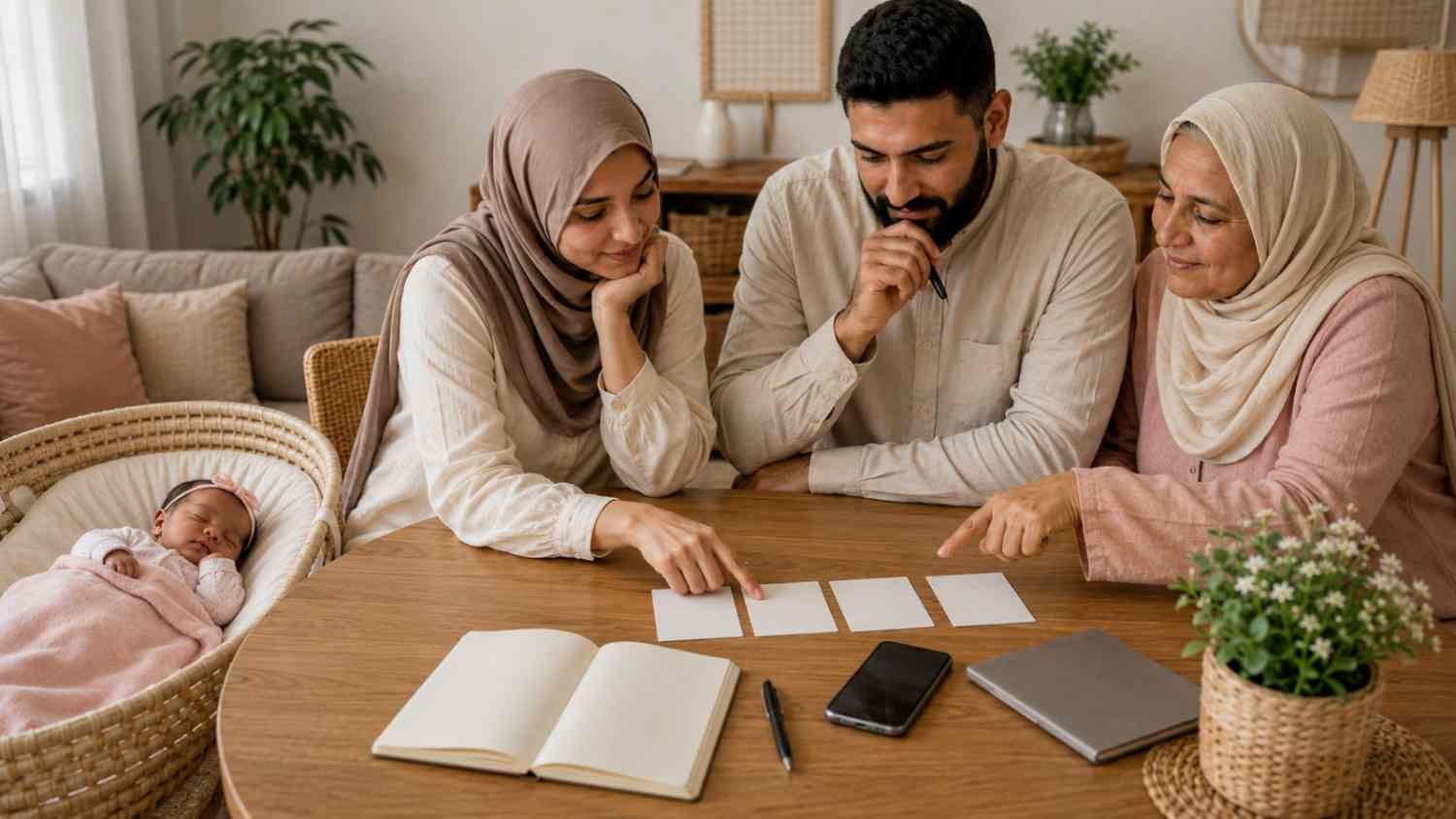
A useful shortlist begins with more than whether a name sounds attractive. Check its established meaning, source language and native form first, then consider how naturally your family can pronounce and spell it in everyday use. Names can travel across languages, and a familiar South Asian form may have Persian roots, while a Turkish name may have developed from an older Arabic or Persian lexical source.
Regional gender use also deserves attention. Baran, for example, can be feminine in Persian naming while being strongly masculine in Turkish and Kurdish contexts. Bakhtawar likewise has genuine female use in South Asia but is not exclusively female. If avoiding cross-gender names matters to your family, this should be part of the decision rather than an assumption made from one baby-name list.
For names presented with a religious or Quranic association, ask what the connection actually is. An exact Arabic word appearing in the Quran, a name sharing a Quranic root, and a personal name belonging to later Islamic history are three different things. Historical associations can still be meaningful, but they should be described accurately.
Finally, test the final three or four choices in ordinary family life. Say each name aloud with the surname, consider likely spellings on school or official documents, check whether close relatives can pronounce it comfortably, and decide whether the name’s linguistic and cultural background fits what you want to preserve.
Pronunciation, Spelling & Transliteration
Parents comparing muslim girl names starting with b may encounter several Roman spellings for one underlying identity. Benazir and Benazeer, Behnoosh and Behnoush, and Barira/Bareera/Barirah/Bareerah are examples in which transliteration can vary without necessarily creating a different name.
Other cases need more caution. Banu, Bano and Banoo are related Persianate regional transmissions, but the form used in one language or community should not automatically be substituted for another. Begüm and South Asian Begum are historically related developments of the same title family rather than simple modern spelling variants.
The same caution applies to visually similar Roman forms. Badi’a — بديعة is not Badiya — بادية, even though the distinction may disappear in simplified Roman spelling. Source-language spelling is therefore especially useful when a Roman form could represent more than one identity.
Arabic, Persian, Urdu & Regional Differences
Bahar, for example, is Persian for “spring,” even when used by Muslim families outside Iran. Benazir is a Persian/Perso-Urdu compound, and Bakhtawar is Persian-derived with strong South Asian transmission. Buse is Turkish in current personal-name use but comes through a Persian lexical source.
Gender can also change across regions. Baran is the clearest example in this collection: it is generally feminine in Persian naming but materially masculine in Turkish and Kurdish settings. This regional difference makes a simple universal “girl name” label misleading.
Banu also illustrates why source language matters. Persian bānū means “lady” or a woman of rank and has developed regional forms such as Bano and Banoo. It is unrelated to Arabic banū, which means “sons” or “descendants of.”
Similarly, Turkish Begüm and South Asian Begum are historically related through a title tradition, but they developed in different regional linguistic settings. They are better treated as related regional forms than as mechanically interchangeable spellings.
Are Muslim Girl Names Starting With B From the Quran?
No name in this 28-name collection should be presented as a female personal name directly supplied by the Quran. The more accurate approach is to distinguish several different kinds of connection.
- Exact Quranic lexical vocabulary: Bushra, Basira, Bayan and Banan occur as words in Quranic Arabic. That does not mean women bearing those names appear in the Quranic narrative.
- Quranic root or lexical-family relationships: Basma, Batul, Bahija, Basima, Bashira, Badi’a and the Arabic source behind Turkish Beyza have related linguistic connections, but this is not the same as being Quranically named women.
- Islamic historical or traditional association: Bilqis is the traditional name associated with the Queen of Sheba, although the Quran does not supply “Bilqis” as her personal name. Barira is historically associated with an early Muslim woman.
- No required Quranic claim: The remaining names are better understood through Persian, Urdu/South Asian, Turkish or other linguistic and regional naming traditions rather than through a Quranic label.
Across the final inventory, this gives four names with exact Quranic lexical forms, seven with root or lexical-family connections, two with historical or traditional Islamic associations, and fifteen for which no Quranic naming claim is needed. These distinctions help prevent a lexical word, a shared root and a historical Muslim bearer from being presented as if they were the same kind of evidence.
Frequently Asked Questions
Bushra, Basma, Batul and Bilqis are long-established choices in many Muslim communities, while Banu and Benazir are particularly recognizable in Persianate and South Asian contexts. Familiarity can still vary by country and language, so it is better to treat these as established examples rather than claim universal popularity.
When reviewing muslim girl names starting with b, it is more accurate to distinguish Quranic vocabulary from Quranic personal names. Bushra, Basira, Bayan and Banan occur as exact lexical forms in Quranic Arabic, but none is presented there as the personal name of a woman.
Bushra is an exact Quranic Arabic word meaning “good news” or “glad tidings.” Its use as a female personal name is established, but the Quran does not narrate a woman whose personal name is Bushra.
No. Both Bayan and Banan are cross-gender in personal-name use. Families who specifically want a female-only naming identity may wish to consider that distinction when comparing alternatives.
It depends strongly on region. Baran is generally feminine in Persian naming, while Turkish and Kurdish usage is materially masculine. It should therefore be treated as cross-gender with a pronounced regional shift.
They are closely related Persianate regional transmissions, but they should not be assumed to be mechanically interchangeable in every linguistic or family context. Also, Persian bānū is unrelated to Arabic banū, meaning “sons” or “descendants of.”
They are historically related forms from the same title family, but Turkish Begüm is not simply a modern alternate spelling of South Asian Begum. Their regional linguistic development should be preserved when identifying the form a family actually uses.
Related Muslim Girl Name Guides
If you are comparing names across initials or want a broader shortlist, continue with these HuntBliss guides:
- Muslim Baby Girl Names
- Islamic Baby Girl Names from Quran
- Modern Muslim Girl Names
- Muslim Girl Names Starting With S
- Unique Muslim Girl Names
- Beautiful Muslim Girl Names
- Muslim Girl Names Starting With A
- Top 100 Muslim Girls Names
- Muslim Girl Names Starting With F
- Muslim Girl Names Starting With N
- Indian Muslim Girl Names
- Muslim Girl Names Starting With D
- Muslim Girl Names Starting With T
- Muslim Twin Baby Girl Names
- Muslim Girl Names Starting With I
- Muslim Girl Names Starting With Z
Conclusion
This collection of muslim girl names starting with b brings together 28 names from Arabic, Persian, Persianate South Asian and Turkish traditions, including familiar choices, lexical names, historically associated names and region-sensitive forms. The most useful shortlist is one that considers not only meaning but also source language, pronunciation, spelling, gender use and the way a name functions in your own family and community.
Quranic terminology also deserves careful handling: an Arabic word occurring in the Quran is not automatically the name of a Quranic woman, and a shared root is different again from an exact lexical occurrence. Once those distinctions are clear, parents can narrow the list to a practical three or four names and compare them calmly for meaning, everyday usability and cultural fit.
Why Trust HuntBliss
HuntBliss treats name research as a normalization and verification task rather than simply collecting spellings from multiple lists. Transliteration variants are consolidated when they represent one underlying identity, while superficially similar forms are kept separate when their source spellings or meanings differ.
Meanings are stated conservatively, Arabic, Persian, Urdu/South Asian and Turkish origins are distinguished where relevant, and cross-gender or region-sensitive usage is flagged rather than hidden. Quranic lexical evidence, root relationships and later Islamic historical associations are also treated as separate categories so that attractive but unsupported claims are not added to a name.
Editorial & Copyright Note
Name spellings can vary across languages, regions and transliteration systems, and some established lexical meanings may carry more than one legitimate nuance. This article is provided for informational and naming-research purposes; families may also wish to confirm local pronunciation or traditional usage within their own community.
HuntBliss editorial research, organization and explanatory text are original site content. Quotation, citation and limited reference should respect applicable copyright principles, while substantial duplication or republication should not reproduce the article as a substitute for the original HuntBliss publication.
Sources
- Quranic Arabic Corpus — a linguistic corpus for Quranic word forms, morphology and roots.
- Vajehyab / Dehkhoda — useful for the Persian-derived names and compounds in this article.
- Türk Dil Kurumu (TDK) Dictionaries — the official Turkish Language Association dictionary portal; it also contains its personal-names dictionary.